
Best Supplements for Mental Clarity — Evidence-Based Rankings
Introduction
The supplement market for brain health is enormous — and largely unregulated. Hundreds of products claim to sharpen focus, eliminate brain fog, and supercharge cognitive performance. Most of them are not worth your money.
This guide cuts through the noise with a straightforward evidence standard: only supplements with published, peer-reviewed clinical research demonstrating meaningful cognitive effects in humans are included. Animal studies, theoretical mechanisms, and anecdotal reports do not make the cut.
What follows are the five supplements with the strongest evidence for improving mental clarity in adults — along with honest dosing information, timing guidance, and realistic expectations.
The Evidence Standard
Before diving in, it is important to calibrate expectations.
No supplement produces effects comparable to pharmaceutical cognitive enhancers. The supplements below produce real but moderate improvements in cognitive function — improvements that are meaningful in daily life but should not be expected to feel dramatic in the way caffeine does.
They are best understood as foundations — compounds that address nutritional deficiencies, reduce neuroinflammation, support neurotransmitter production, and create the neurological conditions in which your brain can function closer to its potential.
#1 — Magnesium L-Threonate
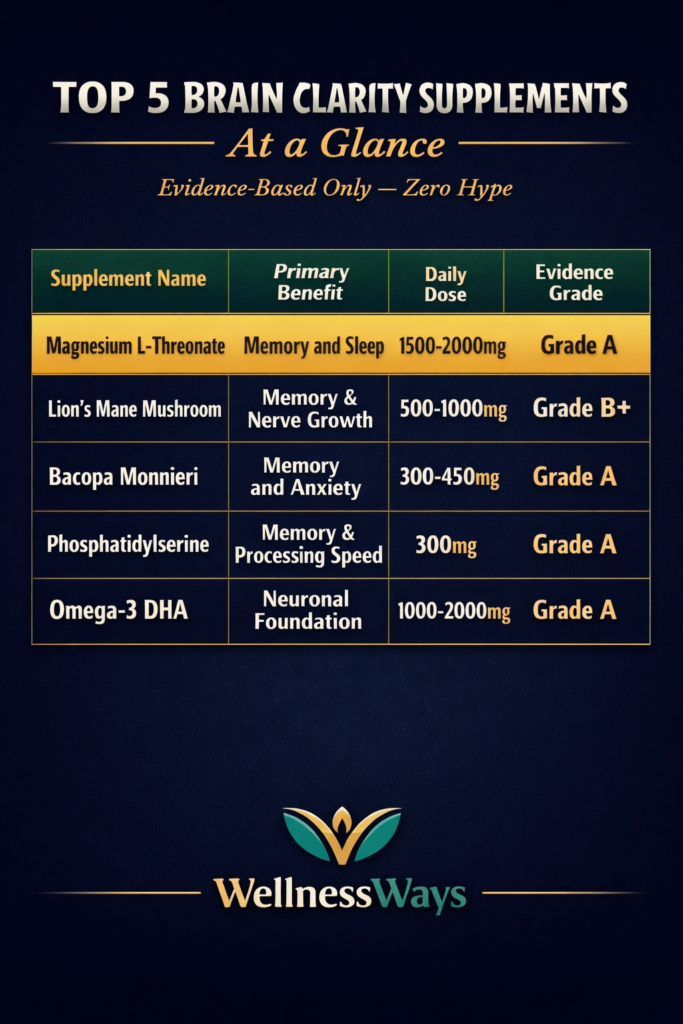
Primary benefit: Memory, focus, sleep quality, cognitive aging Evidence grade: A (multiple randomized controlled trials in humans)
Magnesium is involved in over 300 enzymatic reactions in the body, including many central to neurological function. Approximately 50 percent of adults are estimated to be deficient in magnesium — and this deficiency directly impairs memory, sleep quality, and stress resilience.
Magnesium L-Threonate is uniquely valuable because it is the only form of magnesium clinically demonstrated to cross the blood-brain barrier and raise brain magnesium levels. Standard magnesium supplements (citrate, oxide, glycinate) are useful for other purposes — but they do not meaningfully raise brain magnesium.
A landmark study published in Neuron (2010) by Dr. Guosong Liu at MIT found that magnesium L-Threonate increased synaptic density and significantly improved both short-term and long-term memory in animal models. A follow-up human clinical trial (2016, Journal of Alzheimer’s Disease) demonstrated significant improvements in cognitive ability in adults aged 50 to 70.
Dose: 1,500 to 2,000 mg daily (standardized to 144 mg elemental magnesium) Timing: Evening — also supports sleep quality Onset: 4 to 6 weeks for cognitive effects
#2 — Lion’s Mane Mushroom (Hericium erinaceus)
Primary benefit: Memory, focus, nerve regeneration, mood Evidence grade: B+ (multiple human trials with promising results)
Lion’s Mane is a culinary and medicinal mushroom that has been used in traditional Asian medicine for centuries. Modern research has identified two unique bioactive compounds — hericenones and erinacines — that stimulate the production of Nerve Growth Factor (NGF) in the brain.
NGF is essential for the survival, maintenance, and growth of neurons — particularly in the hippocampus and frontal cortex. Compounds that stimulate NGF are of enormous interest in neurodegeneration research.
A 2009 double-blind, placebo-controlled study in Phytotherapy Research found that adults aged 50 to 80 who took Lion’s Mane (1,000 mg three times daily) for 16 weeks showed significantly higher scores on cognitive function tests than the placebo group — with cognitive scores declining after supplementation was stopped.
A 2023 randomized controlled trial in older adults found that 12 weeks of Lion’s Mane supplementation significantly improved associative learning and short-term memory.
Dose: 500 to 1,000 mg daily (look for products standardized to beta-glucan content) Timing: Morning with food Onset: 6 to 12 weeks for full cognitive effects
#3 — Bacopa Monnieri
Primary benefit: Memory consolidation, anxiety reduction, information processing Evidence grade: A (multiple replicated human RCTs)
Bacopa Monnieri is an Ayurvedic herb with one of the strongest evidence bases of any cognitive supplement. Its active compounds — bacosides — appear to modulate neurotransmitter systems and enhance the efficiency of signal transmission between neurons.
A 2001 study published in Psychopharmacology found that Bacopa supplementation significantly improved speed of visual information processing, learning rate, and memory consolidation in adults. These findings have been replicated in multiple subsequent studies.
Bacopa is notable for also reducing anxiety — making it particularly useful for individuals whose mental clarity is compromised by chronic stress or anxious thought patterns.
Critical timing note: Bacopa takes 8 to 12 weeks to produce its full cognitive effects. This is not a fast-acting supplement — it works through gradual neurochemical adaptation. Many people who report that Bacopa “doesn’t work” simply did not take it long enough.
Dose: 300 to 450 mg daily (standardized to 55% bacosides) Timing: With food — Bacopa can cause nausea on an empty stomach Onset: 8 to 12 weeks
#4 — Phosphatidylserine
Primary benefit: Memory, attention, processing speed, cognitive aging Evidence grade: A (FDA-qualified health claim exists for this supplement)
Phosphatidylserine (PS) is a phospholipid that makes up approximately 15 percent of the total fat in the human brain. It is a critical component of neuronal cell membranes — maintaining their fluidity, permeability, and the integrity of the receptors embedded within them.
PS is the only brain supplement to have received a qualified health claim from the US FDA: “Consumption of phosphatidylserine may reduce the risk of dementia and cognitive dysfunction in the elderly.”
Multiple clinical trials have demonstrated that PS supplementation improves memory recall, attention, mental flexibility, and processing speed in adults with age-related cognitive decline — with effects observable in as little as six weeks.
Dose: 100 mg three times daily (300 mg total) Timing: With meals Onset: 6 to 8 weeks Note: Soy-derived PS is the most studied form. Sunflower-derived PS is available for those avoiding soy.
#5 — Omega-3 DHA (Docosahexaenoic Acid)
Primary benefit: Neuronal membrane function, synaptic plasticity, neuroprotection, mood Evidence grade: A (extensive research base across multiple decades)
DHA is the most abundant omega-3 fatty acid in the human brain, comprising approximately 97 percent of all omega-3s in brain tissue. It is a structural component of neuronal membranes and is directly involved in synaptic plasticity — the flexibility of neural connections that underlies learning and memory.
Low DHA status is associated with accelerated cognitive aging, depression, ADHD, and increased Alzheimer’s risk. Given that the primary dietary source of DHA is fatty fish — and most adults consume far less than recommended — supplementation is frequently warranted.
Unlike the other supplements on this list, DHA is a nutritional baseline rather than a therapeutic compound. Your brain requires it to function normally. If you are not eating fatty fish at least twice per week, you are likely suboptimal.
Dose: 1,000 to 2,000 mg DHA daily (check the DHA content on the label — the total omega-3 figure is not the same as DHA) Timing: With meals containing fat for optimal absorption Onset: Baseline benefits are ongoing with consistent intake; cognitive improvements from correcting deficiency typically emerge within 8 to 12 weeks
What to Avoid
The evidence standard matters. Here are the most commonly marketed brain supplements with insufficient human evidence to recommend:
- Racetams (piracetam, aniracetam) — prescription in some countries, unregulated in others, limited quality human evidence
- Most proprietary “focus blend” supplements — underdosed ingredients hidden behind proprietary labels
- Ginkgo Biloba — once popular, the evidence for cognitive benefit in healthy adults has not held up well in large-scale trials
- Huperzine A — interesting mechanism but limited and inconsistent human evidence
Building a Stack — Where to Start
If you are new to cognitive supplementation, start with one compound and assess its effects before adding another. The most practical starting point for most adults:
Month 1: Magnesium L-Threonate (addresses the most common deficiency, improves both cognition and sleep) Month 2: Add Omega-3 DHA (foundational neuronal nutrition) Month 3: Add Lion’s Mane or Bacopa depending on your primary concern (memory vs. stress/processing)
Give each addition at least 8 weeks before evaluating — these are not fast-acting stimulants.
Conclusion
Mental clarity is not found in a bottle — but the right supplements, based on real evidence and proper dosing, can meaningfully support the neurological conditions in which clarity emerges.
The five compounds above represent the most evidence-supported additions to a comprehensive brain health strategy that includes sleep, nutrition, exercise, and stress management.
[Read our Glymphatic System guide to understand how sleep affects your brain’s ability to benefit from these supplements →] | [Take the Brain Fog Root Cause Quiz to identify your primary driver →]
Disclaimer: This article is for informational purposes only. Consult a healthcare professional before starting any supplement regimen, particularly if you take medications or have a medical condition.