
The Science of Sleep and Brain Health — What Happens to Your Brain While You Sleep
Most of us think of sleep as the absence of activity. We close our eyes, switch off, and pick up where we left off in the morning.
The truth couldn’t be more different.
While you sleep, your brain is running one of the most complex, coordinated, and biologically critical maintenance programs in the human body. Memory is being consolidated, toxins are being flushed, emotions are being processed, and neural connections are being rebuilt.
Sleep isn’t downtime. It’s your brain’s most productive shift of the day.
Here’s exactly what’s happening inside your brain every single night — and why getting it right is one of the most important things you can do for your long-term cognitive health.
The Brain’s Nightly Cycles — A Precise Architecture
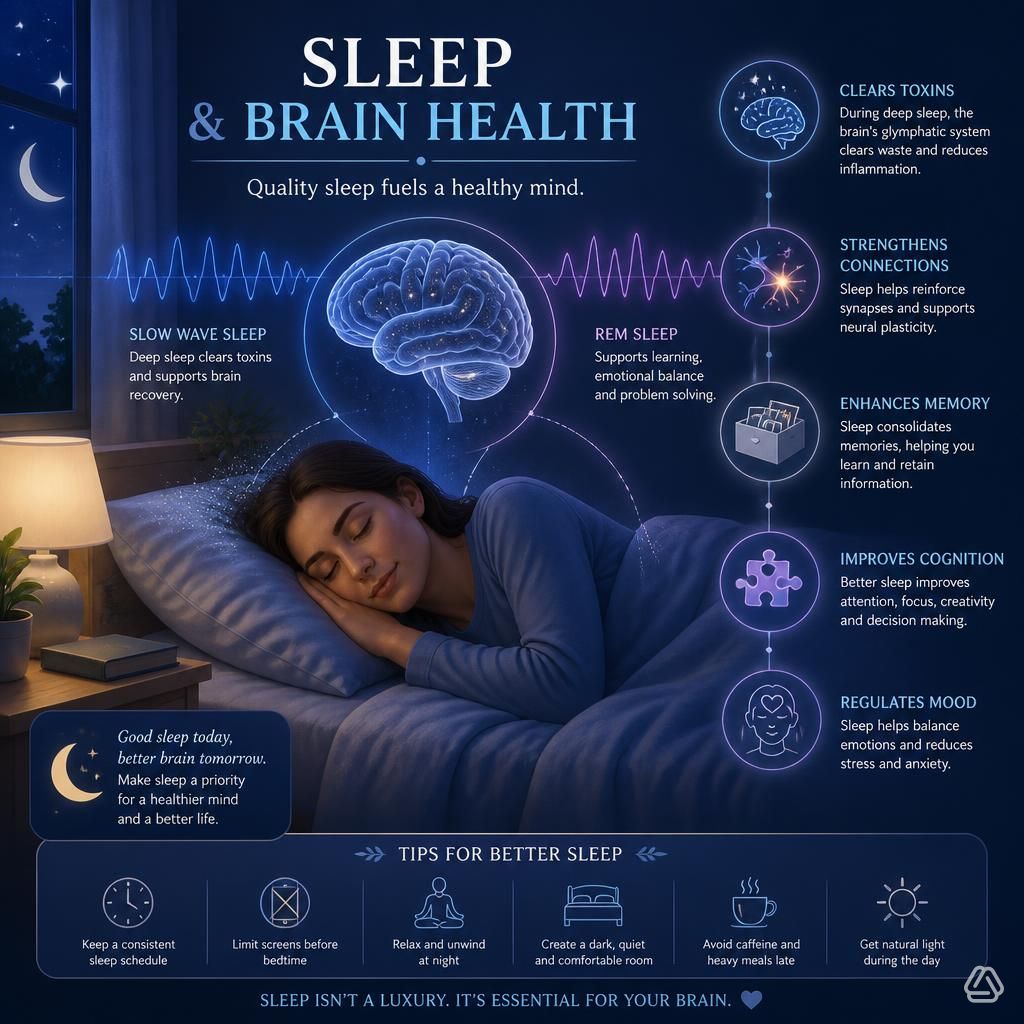
Your brain doesn’t simply “switch to sleep mode.” It moves through a highly organized sequence of 4–5 sleep cycles per night, each lasting approximately 90 minutes and containing distinct stages with completely different functions.
Stage 1 — Light Sleep (NREM 1)
Duration: 1–7 minutes per cycle
The transition from wakefulness to sleep. Brain waves slow from beta (alert) to alpha and theta frequencies. Muscles begin to relax — often producing the sudden jerking sensation called a hypnic jerk as the motor system hands over to sleep architecture.
Stage 2 — Light Sleep (NREM 2)
Duration: 10–25 minutes per cycle
Heart rate slows. Core body temperature drops. The brain begins producing bursts of activity called sleep spindles — rapid oscillations of neural firing that are now understood to be critical for motor learning and procedural memory consolidation. Every physical skill you practiced that day — from typing to sport to music — is being locked into neural circuits during Stage 2.
Stage 3 — Deep Sleep (NREM 3 / Slow Wave Sleep)
Duration: 20–40 minutes per cycle, mostly in the first half of the night
This is where the most profound brain restoration happens. Large, synchronized delta waves sweep through the brain in slow oscillations. During this stage:
- Growth hormone is released — triggering tissue repair throughout the body
- Memory consolidation moves important information from short-term to long-term storage
- Immune function is dramatically enhanced
- The glymphatic system (your brain’s waste clearance system) activates at full capacity
The glymphatic system deserves special attention — it’s one of the most important scientific discoveries of the last decade, and it only operates during deep sleep.
REM Sleep — Rapid Eye Movement
Duration: 10–60 minutes per cycle, increasing toward morning
REM sleep is where your brain becomes remarkably active — in some ways more active than waking consciousness. This is where:
- Emotional memories are processed and integrated — the emotional charge is separated from the factual content, which is why sleep literally makes problems feel more manageable
- Creative connections form between distantly related concepts — REM sleep is strongly associated with insight, creativity, and problem-solving
- Long-term memory is consolidated — particularly emotional, autobiographical, and associative memories
- Dreams occur — now understood to be part of the memory and emotional processing function
The Glymphatic System — Your Brain’s Overnight Cleaning Crew
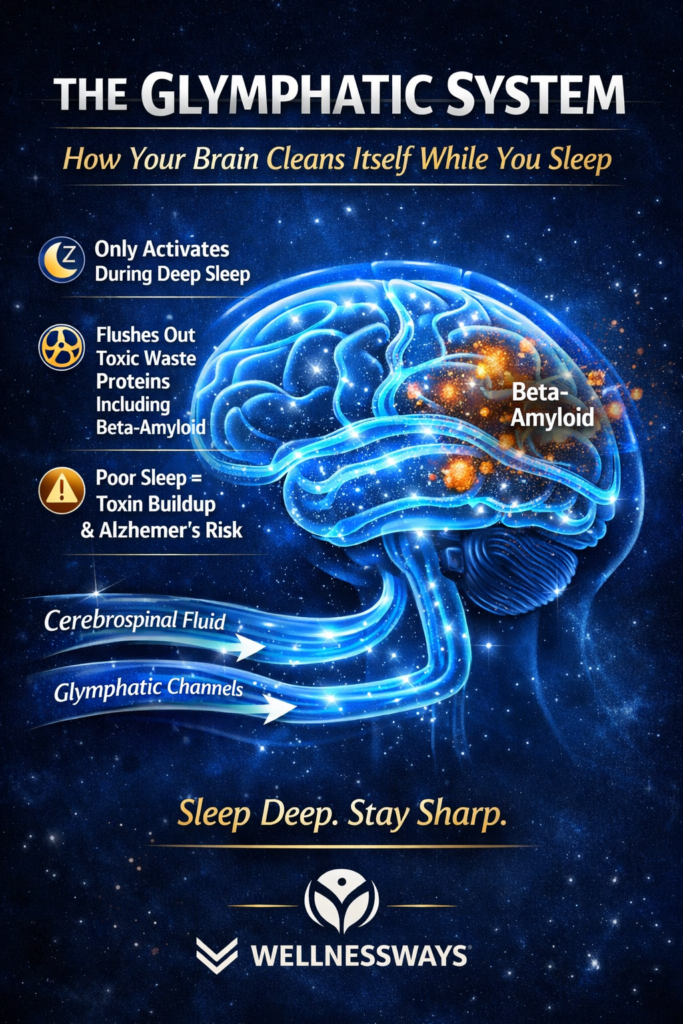
Discovered by Dr. Maiken Nedergaard at the University of Rochester in 2013, the glymphatic system is arguably the most important sleep-related discovery in modern neuroscience.
During deep sleep, cerebrospinal fluid floods through channels around the brain’s blood vessels, physically flushing out toxic waste proteins that accumulate during waking hours. The most significant of these waste products is beta-amyloid — the protein that forms the plaques associated with Alzheimer’s disease.
The implications are profound: poor sleep directly allows beta-amyloid to accumulate in the brain. Research now consistently shows that even a single night of sleep deprivation produces a measurable increase in beta-amyloid buildup. Chronic poor sleep is one of the strongest modifiable risk factors for Alzheimer’s disease.
This is why our complete guide to how to sleep better naturally frames sleep not as a lifestyle preference but as a fundamental health necessity — because at the neurological level, that’s exactly what it is.
Sleep and Memory — The Filing System Your Brain Runs Overnight
Memory consolidation during sleep is one of the most well-documented phenomena in neuroscience. The process works in two stages:
During the day: New experiences create temporary neural traces in the hippocampus — a kind of short-term holding area.
During deep sleep: The hippocampus “replays” these experiences and transfers them to the neocortex for long-term storage. This is why studying before sleep is so dramatically more effective than studying in the morning — your brain literally files the information during the night that follows.
This filing process is so important that the amount and quality of deep sleep you get directly determines how much you remember the next day. Research shows that sleep-deprived students recall up to 40% less information than well-rested peers on the same material.
If you’ve been experiencing brain fog — that frustrating sense of poor memory, slow recall, and mental haziness — inadequate deep sleep is one of the most common and most overlooked root causes.
BDNF and Brain Growth During Sleep
BDNF (Brain-Derived Neurotrophic Factor) is your brain’s primary growth and repair protein — responsible for creating new neurons, strengthening existing neural connections, and maintaining overall cognitive performance.
Research shows that BDNF production peaks during sleep — particularly during the slow wave deep sleep phase. This means that every hour of quality sleep you get is actively growing and strengthening your brain at the cellular level.
Conversely, chronic sleep deprivation consistently produces measurable reductions in BDNF levels — contributing to memory impairment, mood decline, and reduced cognitive resilience. This is the same BDNF suppression pathway that chronic stress activates — which is why stressed people who also sleep poorly experience such dramatic cognitive decline.
What Sleep Deprivation Does to the Brain
Understanding what sleep does for the brain becomes even clearer when you look at what happens without it:
| Hours Without Sleep | Cognitive Equivalent | Key Impairments |
|---|---|---|
| 17 hours | BAC of 0.05% | Reaction time, working memory |
| 21 hours | BAC of 0.08% (legally drunk) | Decision making, emotional regulation |
| 24 hours | BAC of 0.10%+ | Severe across all cognitive domains |
After just one night of poor sleep:
- Prefrontal cortex activity drops by up to 30%
- Amygdala reactivity increases by up to 60%
- Working memory capacity decreases by 20–40%
- Emotional regulation becomes significantly impaired
After chronic partial sleep deprivation (6 hours/night for 2 weeks):
- Cognitive performance degrades to levels equivalent to 2 full nights without sleep
- Critically — subjects report feeling fine and don’t perceive their impairment
That last point is arguably the most dangerous finding in sleep science. The sleepier you are, the less accurately you assess your own impairment.
Optimizing Your Sleep for Maximum Brain Health
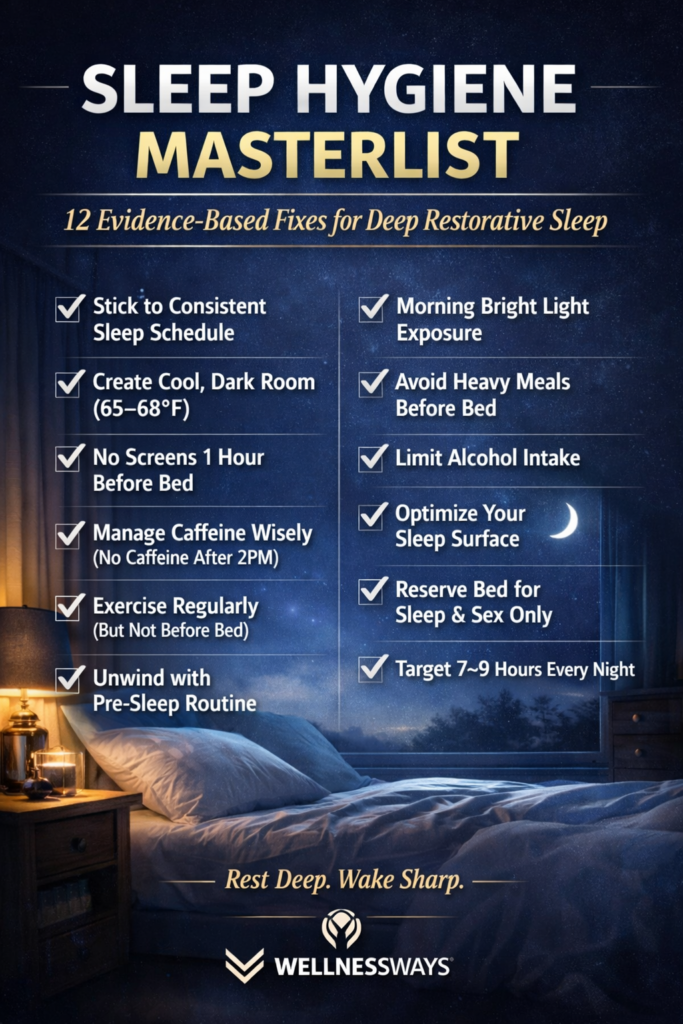
Understanding the science makes the “why” behind sleep optimization unmistakably clear. The key levers:
Deep Sleep (Stages 3): Enhanced by consistent sleep timing, cool bedroom temperature (65–68°F), physical exercise, alcohol avoidance, and magnesium glycinate supplementation.
REM Sleep: Enhanced by sleeping longer (REM is front-loaded in the final sleep cycles), avoiding alcohol (which suppresses REM dramatically), and managing stress levels.
Overall Sleep Quality: Our comprehensive how to sleep better naturally guide covers every evidence-based strategy for optimizing all sleep stages in detail.
The Bottom Line
Sleep is not passive rest. It’s an active, complex, precisely orchestrated biological process that determines your memory, your mood, your cognitive performance, your brain’s physical health, and your long-term risk of neurodegenerative disease.
Every night you invest in quality sleep, your brain is being cleaned, repaired, and rebuilt. Every night you shortchange it, you’re making a withdrawal from your cognitive bank account — one that compounds over time in ways that are now measurable and undeniable.
The science is settled. Sleep is non-negotiable.
Ready to start optimizing your sleep tonight? Read our complete evidence-based guide: How to Sleep Better Naturally and our Ultimate Morning Routine for All-Day Energy — because great sleep and great mornings are two sides of the same coin.
Not sure what’s causing your brain fog? Take our free 3-minute Root Cause Quiz and get your personalized action plan! → [Take The Quiz]