
How Does Phone Use Affect Sleep – Is Sleep Destruction Occurring, And Exactly What to Do About It
You know you should put the phone down before bed. You’ve heard it a hundred times. And yet — there you are at 11pm, scrolling through one more video, reading one more article, checking one more notification.
Here’s the thing: this isn’t entirely a willpower problem. Your phone is specifically engineered to capture and hold your attention, and it deploys several powerful biological mechanisms to disrupt your sleep in the process. Understanding exactly what’s happening — at the neurological and physiological level — makes it much easier to actually change the behavior.
Here’s the full picture, and the evidence-based protocol to fix it.
The Four Ways Your Phone Destroys Sleep
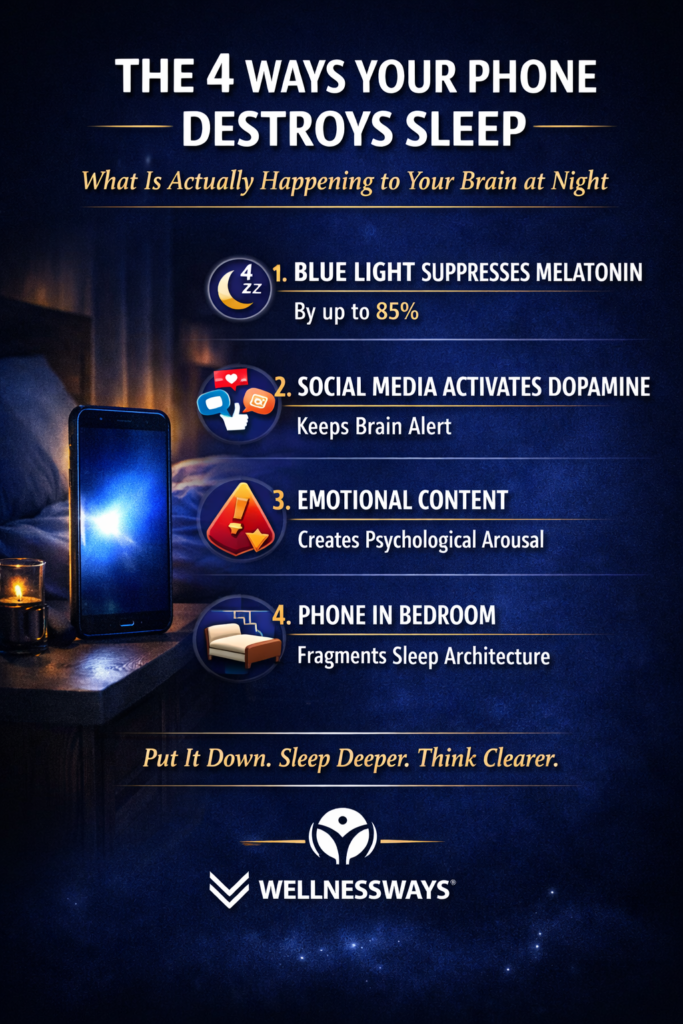
1. Blue Light Suppresses Melatonin — Directly
This is the most well-known mechanism, but most people don’t fully appreciate how significant the effect is.
Your phone, tablet, and computer screens emit blue light in the 440–490nm wavelength range — the same spectrum as daylight. Your brain evolved to use blue light as its primary signal that it’s daytime and therefore not time to sleep. Specifically, specialized photoreceptor cells in your retina called ipRGCs (intrinsically photosensitive retinal ganglion cells) detect blue light and signal the suprachiasmatic nucleus (your circadian master clock) to suppress melatonin production via the pineal gland.
The research on this is striking. A landmark Harvard study found that blue light exposure in the evening suppresses melatonin production by up to 85% compared to dim light. It also delays melatonin onset by up to 3 hours — meaning if you normally feel sleepy at 10pm, phone use until midnight can push your natural sleep window back to 1am.
A 2015 study published in PNAS comparing iPad use before bed to reading a printed book found that iPad readers:
- Took significantly longer to fall asleep
- Had reduced melatonin secretion
- Experienced less REM sleep
- Felt significantly more sleepy the following morning despite equivalent time in bed
The effect is real, measurable, and significant — even at typical evening screen brightness levels.
2. Social Media Activates Your Dopamine System
Beyond blue light, the content of what you’re consuming on your phone creates a second, separate sleep-disrupting mechanism.
Social media platforms are specifically designed around variable ratio reinforcement — the same psychological mechanism that makes slot machines addictive. Every scroll has the potential to deliver a reward (a funny video, an interesting post, a notification, a like) — but you never know when. This unpredictability is precisely what drives compulsive behavior and makes it neurologically difficult to stop.
Each reward (or anticipation of reward) triggers a dopamine release in the mesolimbic reward system. Dopamine is an activating, arousing neurotransmitter — the neurochemical opposite of what you need when trying to fall asleep. Sustained dopamine activation in the hour before bed keeps your brain in a high-alert, seeking state that directly conflicts with the calm, deactivated state required for sleep onset.
This is why people who watch neutral content on a screen before bed (like a documentary) tend to sleep better than those on social media — even with identical screen time and blue light exposure.
3. News and Content Creates Psychological Arousal
The third mechanism is psychological rather than neurochemical. Emotionally engaging, stimulating, or distressing content — news, controversial social media, exciting videos, or even engrossing podcasts — activates your amygdala and prefrontal cortex, creating psychological arousal that persists long after the screen goes dark.
Research consistently shows that cognitive and emotional arousal before bed is one of the strongest predictors of sleep onset difficulty. When your brain is actively processing information, debating ideas, or experiencing emotional responses, it cannot simultaneously transition into the theta-wave activity associated with sleep onset.
The content you consume in the hour before bed literally shapes the cognitive state you try to fall asleep in. Stressful news = stressed brain trying to sleep. Exciting social content = stimulated brain trying to sleep.
4. Phone Checking Fragments Early Sleep
The fourth mechanism operates even after you put the phone down. If your phone is in your bedroom and you’re in the habit of checking it — for the time, for notifications, for “just one thing” — each instance of checking can fragment your sleep architecture.
Even brief light exposure from a phone screen during the night can suppress melatonin and shift your circadian phase. And the psychological habit of phone checking at night keeps a portion of your brain in “monitoring mode” — a state of light vigilance that prevents the deepest, most restorative stages of sleep from occurring properly.
The Real Cost — What Sleep Disruption Does to Your Brain
This isn’t just about feeling groggy. As detailed in our complete guide on how to sleep better naturally, chronic sleep disruption has serious documented consequences:
- Glymphatic system impairment — your brain cannot properly flush toxic waste proteins including beta-amyloid, increasing long-term Alzheimer’s risk
- Prefrontal cortex suppression — decision-making, focus, and impulse control all degrade
- Amygdala hyperactivation — anxiety and emotional reactivity increase
- BDNF suppression — brain growth protein declines, impairing memory and learning
- Hippocampal shrinkage — long-term structural brain changes with chronic sleep disruption
Understanding that phone-disrupted sleep isn’t just “tiredness” — it’s measurable brain impairment — changes how most people relate to the habit.
The Evidence-Based Fix — Your Evening Phone Protocol
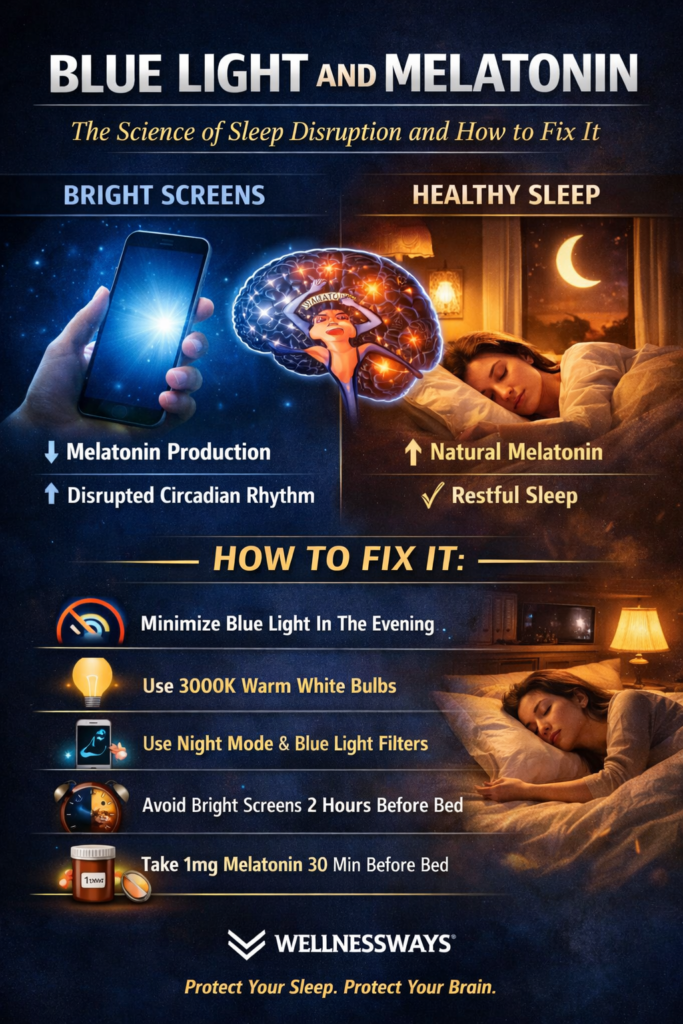
Step 1: The 9pm Rule — No Social Media After 9pm
Set a hard cutoff for social media specifically. News, social platforms, and any content that creates emotional arousal or dopamine-seeking behavior should end at 9pm (or 2 hours before your target sleep time). This is the single highest-leverage change you can make.
Step 2: Enable Night Mode — But Know Its Limits
Night mode (iOS) and Night Light (Android) reduce blue light emission by warming the screen’s color temperature. Research suggests this is helpful but not sufficient on its own — the effect on melatonin suppression is modest. It’s a good layer of protection but shouldn’t replace behavioral changes.
Step 3: Swap Your Bedroom Light to 3000K Warm White
Standard LED lighting also emits significant blue light. Swap your bedroom bulbs to warm white (2700–3000K) bulbs. This simple change — which costs less than $10 — dramatically reduces blue light exposure in your pre-sleep environment.
Step 4: Charge Your Phone Outside the Bedroom
This is the single most effective structural change you can make. When your phone isn’t in the bedroom, you cannot check it during the night, you remove the temptation of pre-sleep scrolling, and you eliminate the low-grade vigilance state that bedroom phone presence creates.
Use a simple alarm clock for wake-up — they cost $10 and work perfectly. The “but I use it as my alarm” excuse disappears immediately.
Step 5: Create a 30-Minute Wind-Down Ritual
Replace the phone habit with a deliberate wind-down routine in the 30 minutes before bed:
- Dim all lights in the home
- Read a physical book or listen to calm audio
- Light stretching or yoga
- Journaling — 3 things you’re grateful for, tomorrow’s top priorities
- Magnesium glycinate + L-Theanine (our complete magnesium guide covers the exact protocol)
Step 6: Use Blue Light Blocking Glasses
If eliminating screen use isn’t realistic on certain evenings, blue light blocking glasses (amber lenses — not clear “blue light” glasses which have minimal effect) physically filter blue wavelengths before they reach your retina. Research confirms that amber lens glasses worn in the evening can substantially reduce melatonin suppression. They look a little strange but work genuinely well.
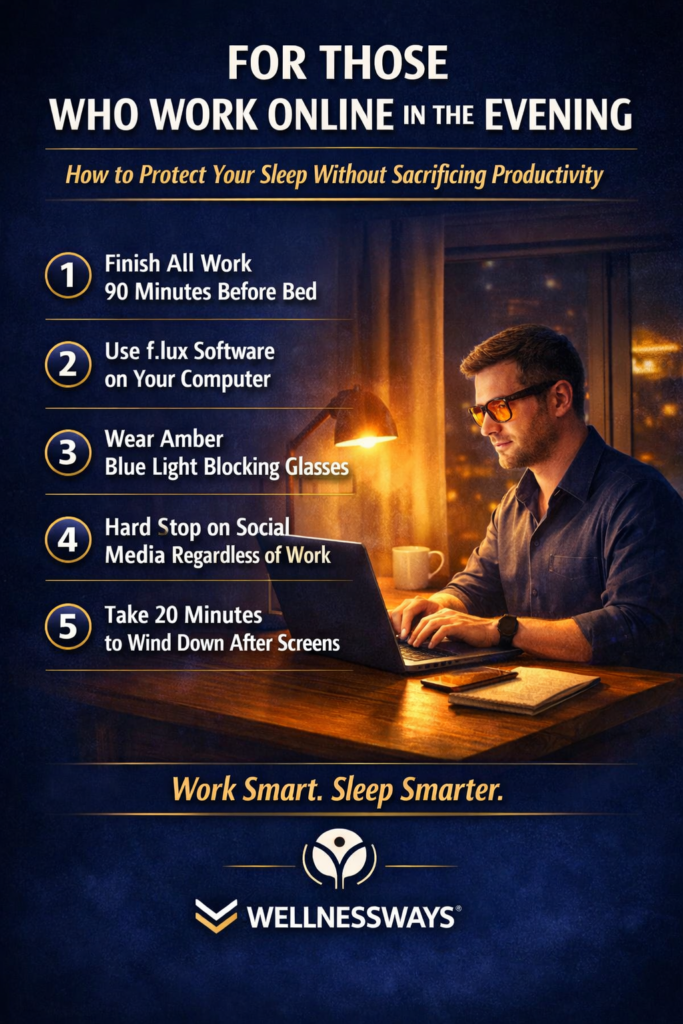
For Those Who Work Online in the Evening
For many people — including content creators, bloggers, and online business builders — complete evening screen avoidance isn’t realistic. Here’s the adapted protocol:
- Finish all work at least 90 minutes before target sleep time
- Use f.lux (free software) on your computer — it automatically warms your screen color as sunset approaches
- Wear amber glasses during any necessary evening screen time
- Hard stop on social media regardless of work screens — these are separable habits
- After screen work: 20 minutes of calm wind-down before sleep — no more screens
The key insight: it’s the dopamine-seeking social content that’s most damaging, not screens per se. Work-focused screen use with night mode enabled is significantly less disruptive than social scrolling.
The Results You Can Expect
People who implement this protocol consistently report:
- Falling asleep faster (typically within 15–20 minutes vs 30–60+ minutes)
- Deeper, more restorative sleep — waking up feeling genuinely rested
- Reduced middle-of-night waking
- Better morning mood and mental clarity
- Reduced evening anxiety
Most people notice meaningful improvement within 3–5 nights of consistent implementation — making this one of the fastest-acting sleep improvements available.
The Bottom Line
Your phone isn’t a neutral bedtime companion. It’s a biological sleep disruptor that suppresses melatonin, activates your dopamine system, creates psychological arousal, and fragments your sleep architecture — often simultaneously.
The fix isn’t complicated: charge it outside your bedroom, cut social media by 9pm, dim your lights, and replace the scroll with a calming wind-down ritual. Your brain will do the rest.
For the complete sleep optimization system, read our ultimate guide to sleeping better naturally — and if you’re waking up groggy regardless of sleep length, read our guide on what is sleep inertia and how to fix it.