
What Is Sleep Inertia — And How Do You Fix It Fast?
You know that groggy, disoriented, “where am I and what year is it” feeling when your alarm goes off? The one that makes the first 20–30 minutes of your morning feel like you’re wading through wet cement?
That’s sleep inertia — and it’s a real, measurable neurological phenomenon that affects millions of people every single morning.
The good news is it’s not permanent, it’s not a character flaw, and it’s absolutely fixable. Here’s exactly what’s happening in your brain — and how to clear it fast.
What Is Sleep Inertia?
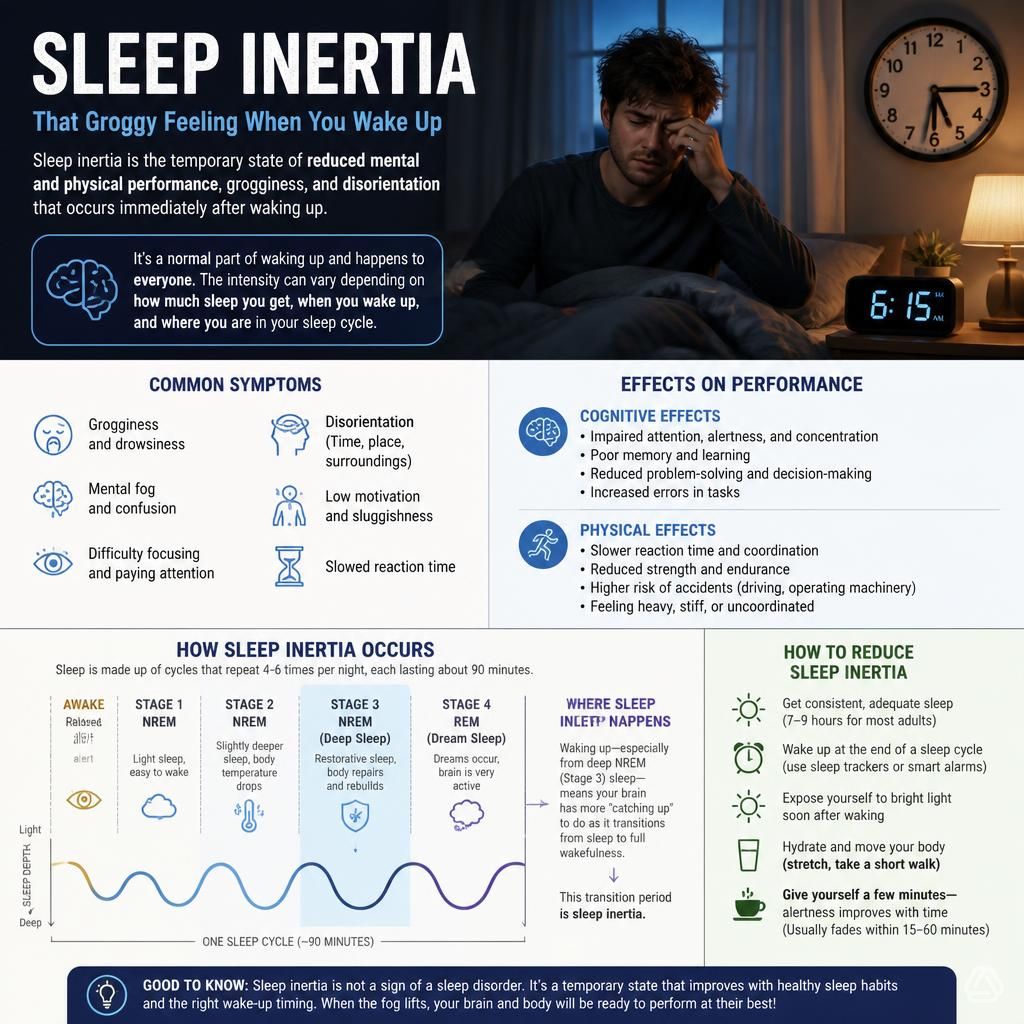
Sleep inertia is the transitional state between sleep and full wakefulness — a period of impaired cognitive performance, grogginess, disorientation, and reduced motor function that occurs immediately after waking.
During sleep inertia, your brain hasn’t fully switched from sleep mode to wake mode. Specifically:
- Adenosine (the sleep pressure chemical) is still elevated in your system
- Cerebral blood flow — particularly to the prefrontal cortex (your decision-making, reasoning center) — is still reduced
- Core body temperature is still rising toward its daytime level
- Cortisol hasn’t yet reached its Cortisol Awakening Response peak
The result is a brain that is technically awake but operating at significantly reduced capacity — sometimes up to 30–50% below normal cognitive performance in the first 15–30 minutes after waking.
Research published in the Journal of Sleep Research found that sleep inertia can impair performance more severely than moderate sleep deprivation in the short term. In other words, the first 15 minutes after your alarm goes off is one of the worst cognitive states you can be in during a normal day.
How Long Does Sleep Inertia Last?
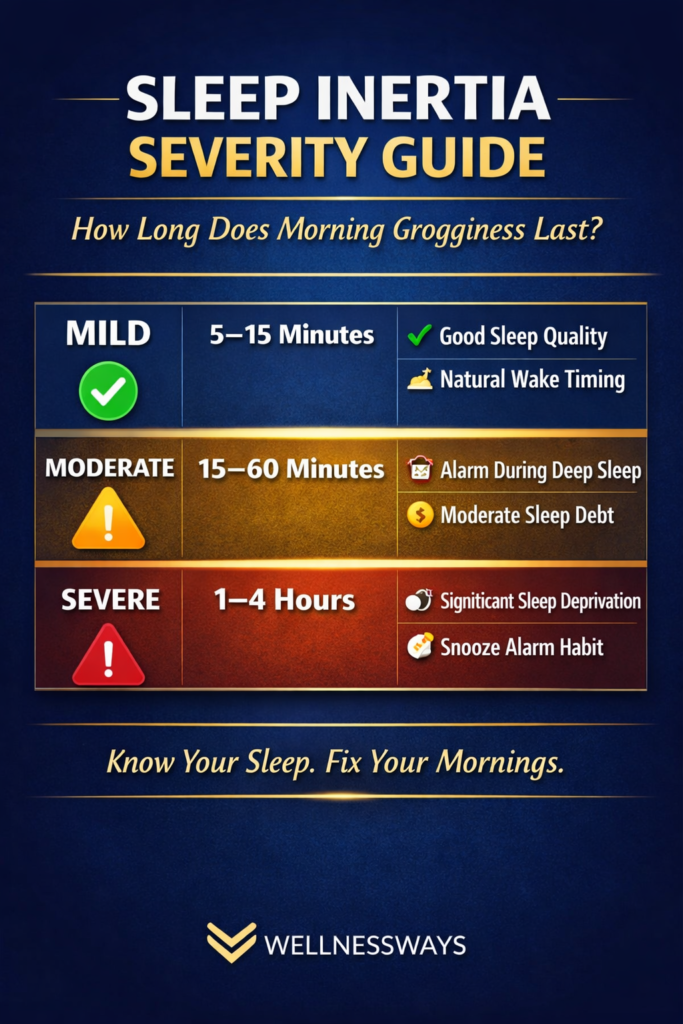
This varies significantly by person and by the factors discussed below — but the typical range is:
| Severity | Duration | Common Causes |
|---|---|---|
| Mild | 5–15 minutes | Good sleep quality, natural wake timing |
| Moderate | 15–60 minutes | Alarm during deep sleep, moderate sleep debt |
| Severe | 1–4 hours | Significant sleep deprivation, sleep disorders, snooze alarm habit |
For most people, sleep inertia resolves within 15–30 minutes. For chronically sleep-deprived individuals, it can last hours — often mistaken for “just not being a morning person.”
What Makes Sleep Inertia Worse?
Several common habits dramatically extend and intensify sleep inertia:
🔴 Hitting the snooze button — the #1 culprit This is the single biggest mistake most people make. When you hit snooze and drift back to sleep, your brain begins a new sleep cycle. When the alarm fires again 9 minutes later, you’re pulled out of the beginning of a sleep cycle — the worst possible time to wake, associated with maximum adenosine and minimum cortisol. The result is sleep inertia that’s significantly worse than if you’d simply gotten up with the first alarm.
🔴 Waking during deep sleep (Stage 3) Your body cycles through light sleep, deep sleep, and REM approximately every 90 minutes. Being woken by an alarm during Stage 3 deep sleep produces the most severe sleep inertia. This is why some people feel dreadful after 8 hours but fine after 6 — it comes down to where in the cycle the alarm hits.
🔴 Chronic sleep deprivation When you’re consistently undersleeping, adenosine buildup is greater and the Cortisol Awakening Response is blunted. Sleep inertia becomes a near-daily problem rather than an occasional one. If you’re waking up groggy every single morning, this is likely a sleep quantity or quality problem — not just a morning routine problem.
🔴 Alcohol the night before As covered in our complete guide on how to sleep better naturally, alcohol dramatically disrupts sleep architecture — suppressing REM sleep and fragmenting deep sleep. The morning after drinking, sleep inertia is consistently more severe and longer lasting.
🔴 Dark, warm environments in the morning Light and temperature are your two most powerful circadian triggers. Waking in a dark, warm room keeps your brain in “sleep condition” — literally extending sleep inertia by depriving it of the signals it needs to shift into wake mode.
7 Ways to Clear Sleep Inertia Fast
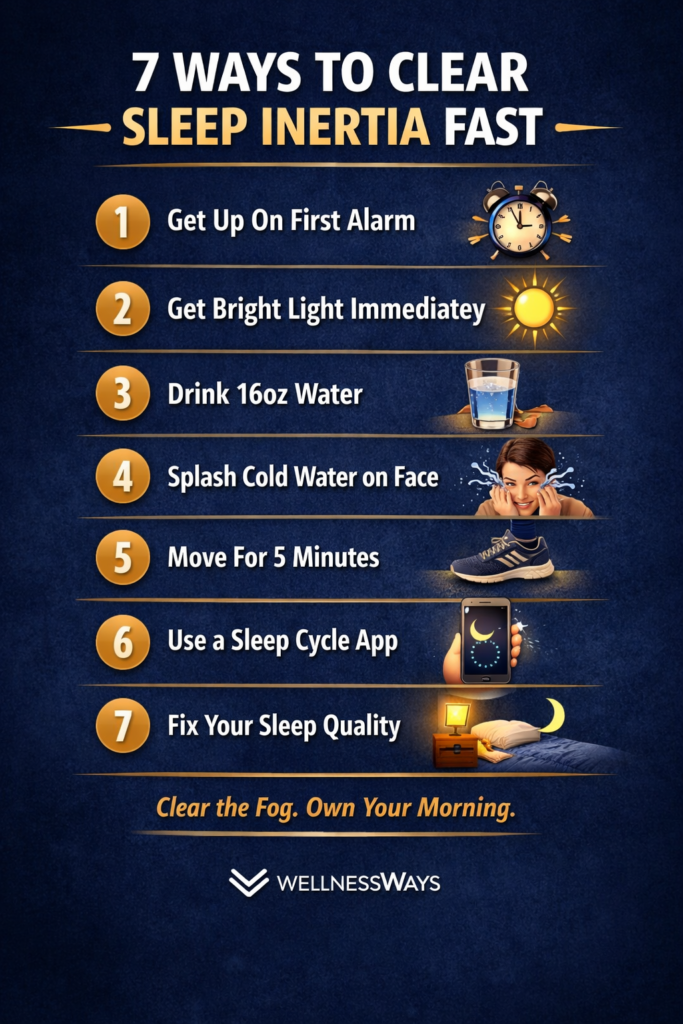
1. Get Up With Your First Alarm — Every Time
This is non-negotiable. The snooze button is not rest — it’s fragmented sleep that makes everything worse. Set one alarm. Get up. The grogginess you feel in that moment is sleep inertia — and it clears within minutes once you start moving. The snooze button extends it for hours.
2. Get Bright Light Immediately
Light is the fastest and most powerful circadian signal available to you. Within the first 5 minutes of waking, open your blinds fully, step outside, or turn on a bright light. Even on a cloudy day, outdoor light is dramatically brighter than indoor lighting and triggers the cortisol response that clears adenosine.
This is one of the core principles of our morning routine for all-day energy — and for good reason. Morning light exposure is genuinely one of the fastest, most evidence-backed ways to eliminate sleep inertia.
3. Drink Water Before Anything Else
You wake up mildly dehydrated after 7–8 hours without fluids. Even mild dehydration amplifies the cognitive impairment of sleep inertia. A large glass of water — 16oz — immediately upon waking rehydrates your brain and literally speeds up the clearance of sleep inertia symptoms.
4. Splash Cold Water on Your Face
Cold water on the face triggers the diving reflex — a rapid parasympathetic-to-sympathetic nervous system switch that increases heart rate, blood pressure, and alertness within seconds. It’s not glamorous but it works remarkably fast.
5. Move Your Body — Even for 5 Minutes
Physical movement rapidly increases cerebral blood flow — literally pushing more oxygenated blood to the prefrontal cortex that’s been running at reduced capacity since you woke up. Even 5 minutes of light movement (jumping jacks, a short walk, stretching) measurably reduces sleep inertia duration.

6. Use a Sleep Cycle Alarm App
Apps like Sleep Cycle, Rise, or AutoSleep track your movement during sleep and wake you during your lightest sleep phase within a 20–30 minute window before your set alarm time. Waking during light sleep instead of deep sleep dramatically reduces sleep inertia severity. This single change can transform your mornings.
7. Fix Your Sleep Quality — The Root Cause
If you’re experiencing severe, prolonged sleep inertia daily, it’s almost always a signal of poor sleep quality or insufficient sleep quantity — not a morning routine problem. Address the root cause: optimize your sleep environment, sleep schedule, and wind-down routine. Our complete guide to how to sleep better naturally covers every evidence-based strategy in detail.
The Strategic Nap and Sleep Inertia
If you nap during the day, sleep inertia is an important consideration. Naps longer than 30 minutes risk entering deep sleep — meaning you’ll wake up groggy and impaired rather than refreshed.
The optimal nap formula:
- Duration: 10–20 minutes (short enough to avoid deep sleep)
- The “nappuccino” technique: Drink a coffee immediately before your nap — caffeine takes 20–30 minutes to absorb, so it kicks in precisely as you wake up, eliminating post-nap sleep inertia entirely
- Timing: Early afternoon (1–3pm) — later naps can interfere with nighttime sleep onset

The Bottom Line
Sleep inertia is a real, neurologically measurable phenomenon — not weakness, laziness, or simply “not being a morning person.” It’s your brain transitioning from sleep to wakefulness, and it clears naturally within minutes to an hour depending on your sleep quality and morning habits.
The fastest way to fix it: get up immediately, get light, get water, get moving. These four actions together can clear sleep inertia in under 10 minutes for most people.
The long-term fix is always better sleep. Build the foundation first — and your mornings will transform.
Struggling with ongoing grogginess and poor sleep quality? Read our complete guide: How to Sleep Better Naturally — the science-backed blueprint for deep, restorative sleep every night.
Not sure what’s causing your brain fog? Take our free 3-minute Root Cause Quiz and get your personalized action plan! → [Take The Quiz]