
7 Signs of Brain Fog — And What’s Actually Causing Each One
You wake up after a full night’s sleep, sit down to start your day, and almost immediately something feels off. Words slip away mid-sentence. You stare at a task you’ve done a hundred times and feel inexplicably stuck. You’re not sick, you’re not depressed — at least not in any way you can clearly name — but your mind just won’t cooperate the way it used to. If you’re in your 40s, 50s, or 60s, this quiet cognitive friction is more common than you might think, and more importantly, it is rarely random. Something specific is driving it.
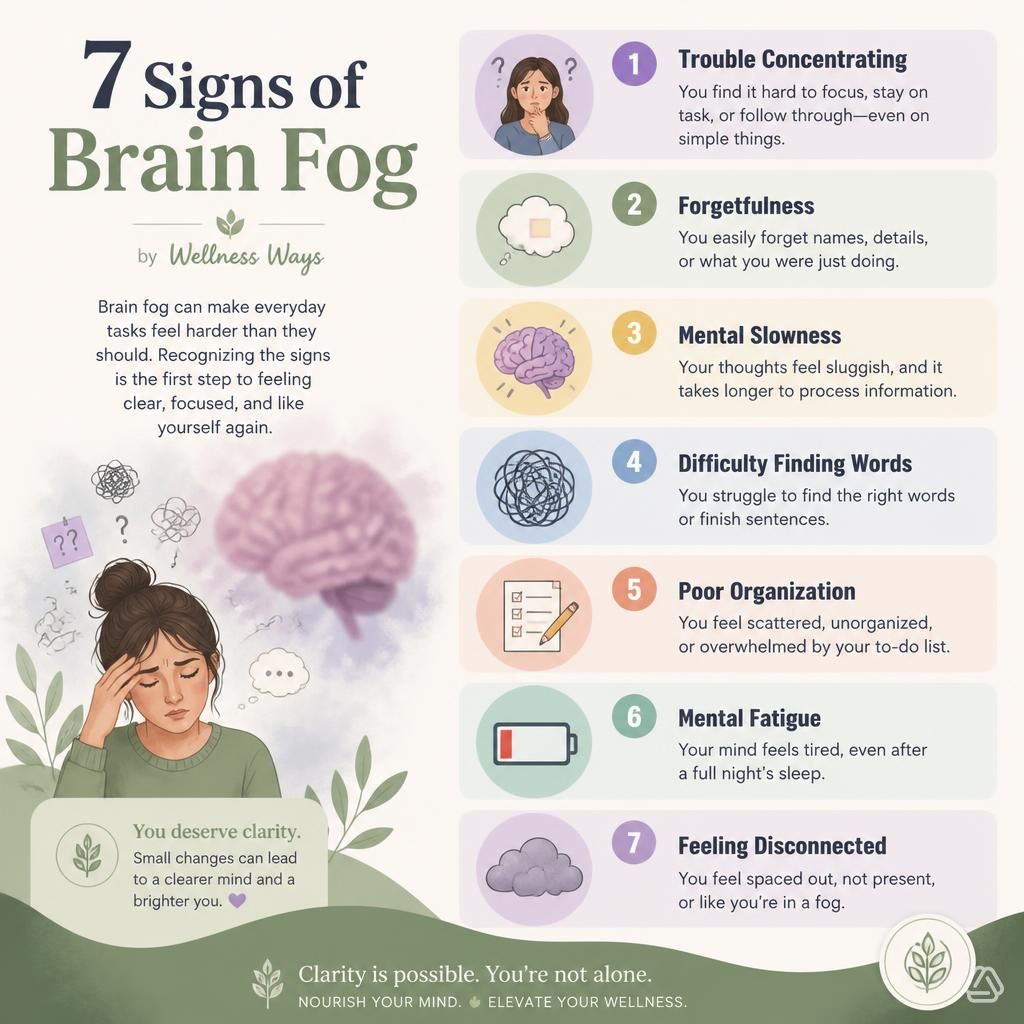
What Exactly Is Brain Fog?
Brain fog is not a medical diagnosis — it is a cluster of symptoms that include mental fatigue, reduced concentration, poor short-term memory, and a general sense of cognitive slowness or cloudiness. It affects tens of millions of adults over 45 and is frequently dismissed as an inevitable part of aging when, in most cases, it is anything but. The most important thing to understand about brain fog is that the symptom itself tells you very little — identifying the root cause is the only thing that leads to meaningful improvement, which is exactly why understanding your personal driver matters so much. (More on that below.)
The 7 Most Common Signs of Brain Fog
1. You Can’t Find the Right Words Mid-Sentence
You know precisely what you mean — the thought is fully formed — but the word to express it simply won’t arrive. This is sometimes called tip-of-the-tongue phenomenon, and while occasional lapses are normal, frequent word-retrieval failures are a meaningful cognitive signal. It often reflects reduced activity in the left prefrontal cortex, the brain’s language-processing hub. When this happens regularly, it warrants attention, not explanation away.
Root Cause Often Linked To: Chronic stress and chronically elevated cortisol, which suppress prefrontal cortex activity and impair verbal fluency circuits.
2. You Read the Same Paragraph Three Times and Still Don’t Retain It
Your eyes move across the words. You finish the page. And then — nothing. No information actually transferred into memory. This isn’t a focus problem alone; it is a consolidation problem. Your brain is receiving information but failing to encode it properly into short-term and working memory. For many adults in this demographic, this symptom is one of the most professionally frustrating, showing up during meetings, while reading reports, or while trying to stay current in their field.
Root Cause Often Linked To: Poor sleep quality and sleep fragmentation. During deep sleep, the brain consolidates memories and clears metabolic waste. Without adequate deep sleep, this process is chronically shortchanged.

3. You Feel Mentally Exhausted by Mid-Morning
You haven’t done anything particularly taxing, yet by 10 a.m. your mental tank already feels depleted. This is not laziness and it is not a motivation problem — it is physiology. The brain is an extraordinarily metabolically demanding organ, consuming roughly 20% of the body’s total energy despite accounting for only about 2% of its mass. When the systems that fuel it are dysregulated, cognitive endurance suffers long before physical fatigue sets in.
Root Cause Often Linked To: Blood sugar dysregulation and metabolic issues. Unstable glucose levels cause the brain to cycle between oversupply and undersupply, producing mental energy crashes that often peak in the mid-to-late morning.
4. You Forget Why You Walked Into a Room
Everyone jokes about this. But when it happens multiple times a day, every day, the joke loses its humor. This phenomenon — sometimes called a doorway effect in research contexts — reflects gaps in working memory, the brain’s ability to hold and manipulate information across short time spans. It becomes more problematic when compounded by nutritional gaps that affect neurotransmitter production and neuronal membrane integrity. Small, consistent nutritional deficiencies can quietly erode working memory over months and years.
Root Cause Often Linked To: Nutritional deficiencies, particularly vitamin B12, omega-3 fatty acids, and magnesium — all critical for neurological function and cognitive performance.
5. Simple Decisions Feel Overwhelming
Choosing what to eat for lunch feels like a project. Selecting between two email response options takes longer than it should. What used to be automatic now requires effortful processing that leaves you drained. Cognitive load has not actually increased — your brain’s capacity to manage it has decreased. When executive function declines, the brain routes even trivial decisions through more effortful, conscious processing pathways, creating a cascade of mental fatigue across the day.
Root Cause Often Linked To: Hormonal imbalances, particularly shifts in estrogen, testosterone, and thyroid hormones — all of which play direct roles in dopamine and serotonin signaling, both essential for decision-making and mental flexibility.
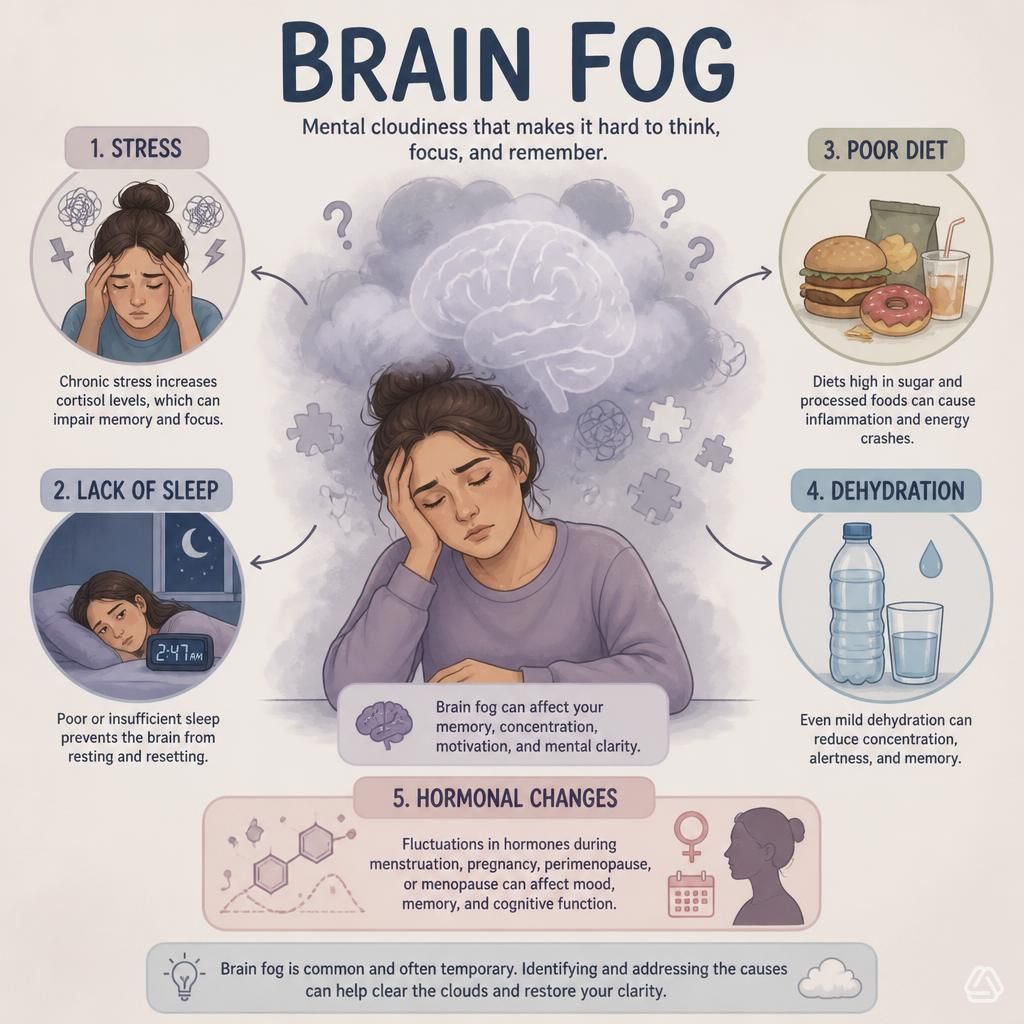
6. You Feel Like You’re Thinking Through Static
It is not that you can’t think — it is that every thought feels like it has to push through resistance. Your mental processes feel slowed, muffled, or like a signal with too much interference. This particular quality of brain fog — the static sensation — is increasingly linked in emerging research to the bidirectional communication network between the gut and the brain. When the gut microbiome is disrupted, the signaling along the vagus nerve and via inflammatory molecules creates real, measurable cognitive interference.
Root Cause Often Linked To: Gut dysbiosis and the gut-brain axis. An imbalanced gut microbiome produces inflammatory signals and disrupts neurotransmitter production (including 90% of the body’s serotonin) in ways that directly impair cognitive clarity.
7. Your Focus Disappears Within Minutes
You sit down with every intention of concentrating. Within two to three minutes, your attention has scattered. Unlike the focus struggles of younger adults, which are often lifestyle-related, this type of rapidly collapsing concentration in adults over 45 frequently reflects an underlying neuroinflammatory process. The brain under inflammatory stress shifts resources away from higher cognitive functions toward its immune defense mechanisms — a priority trade-off that devastates sustained attention.
Root Cause Often Linked To: Toxic load and neuroinflammation. Environmental toxins, heavy metals, mold exposure, and systemic inflammation can trigger microglial activation in the brain, producing a state of low-grade neuroinflammation that directly suppresses focus and processing speed.
Why Identifying YOUR Root Cause Matters
Here is what most generic brain health advice misses entirely: brain fog is not one condition with one solution — it is a symptom that can arise from at least five distinct physiological root causes. Addressing a sleep-driven brain fog with stress-reduction techniques will produce minimal results. Targeting hormonal imbalances with gut-health protocols will leave you spinning your wheels. The research is increasingly clear that personalized, root-cause-targeted interventions produce dramatically better outcomes than broad, generalized approaches. Before you purchase a supplement, change your diet, or download a meditation app, knowing which driver is most dominant for you specifically is the single most leveraged step you can take toward reclaiming your cognitive clarity.
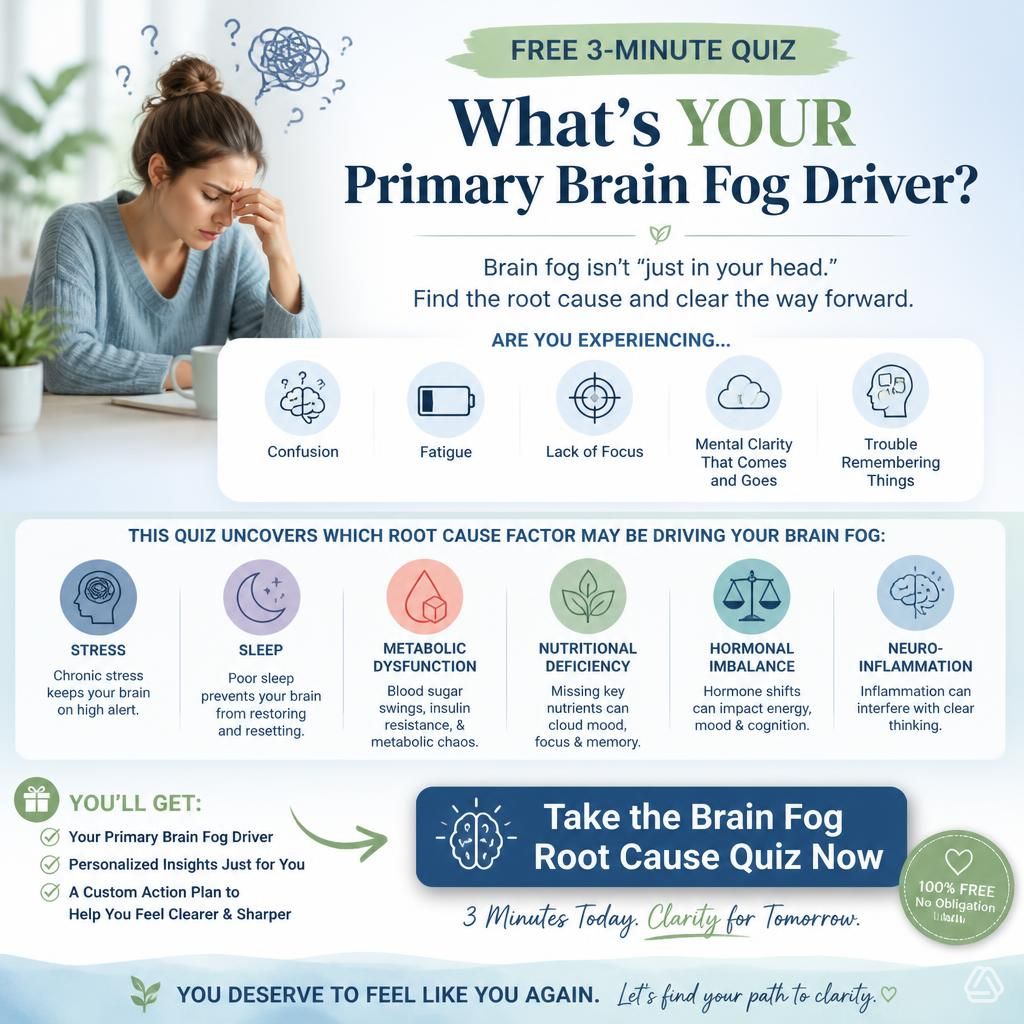
What’s YOUR Primary Brain Fog Driver?
Take the Free 3-Minute Brain Fog Quiz
We built a free 3-minute quiz specifically for adults experiencing the symptoms above. It is designed to identify your #1 root cause driver — whether that is stress, sleep, metabolic dysfunction, nutritional deficiency, hormonal imbalance, or neuroinflammation — and deliver a personalized action plan based on your results. No generic advice. No one-size-fits-all recommendations. Take the Brain Fog Root Cause Quiz now and find out exactly where to focus your energy first.
Resources: Brain Fog Causes and How to Fix It
Medical Disclaimer: This article is for educational and informational purposes only and does not constitute medical advice. Always consult a qualified healthcare professional before making changes to your health routine.