
How to Sleep Better Naturally — The WellnessWays Complete Guide to Restorative Sleep
By daveww2026 | WellnessWays
Published: August 26, 2026
You know the feeling. You’re exhausted — genuinely, bone-tired exhausted — but the moment your head hits the pillow, your brain switches on like a floodlight. Or maybe you fall asleep fine, only to jolt awake at 3am with a racing mind and a to-do list that writes itself in the dark. Sound familiar?
You’re far from alone. Nearly 1 in 3 American adults report not getting enough sleep on a regular basis, according to the Centers for Disease Control and Prevention. And the consequences go far deeper than feeling groggy. Chronic poor sleep directly impairs cognitive function, destabilizes mood, suppresses immune response, disrupts metabolic health, and — perhaps most strikingly — interferes with the brain’s glymphatic system, which flushes out metabolic waste (including proteins linked to Alzheimer’s disease) only during deep sleep.
This isn’t a small problem. It’s a foundational one. And here’s the good news: your biology already knows how to sleep well. It just needs the right conditions. In this guide, WellnessWays breaks down 7 natural, research-backed strategies that work with your body’s own rhythms — not against them. No prescriptions. No quick fixes. Just sustainable habits that actually restore your sleep from the inside out.
Why Natural Sleep Solutions Beat Sleep Aids
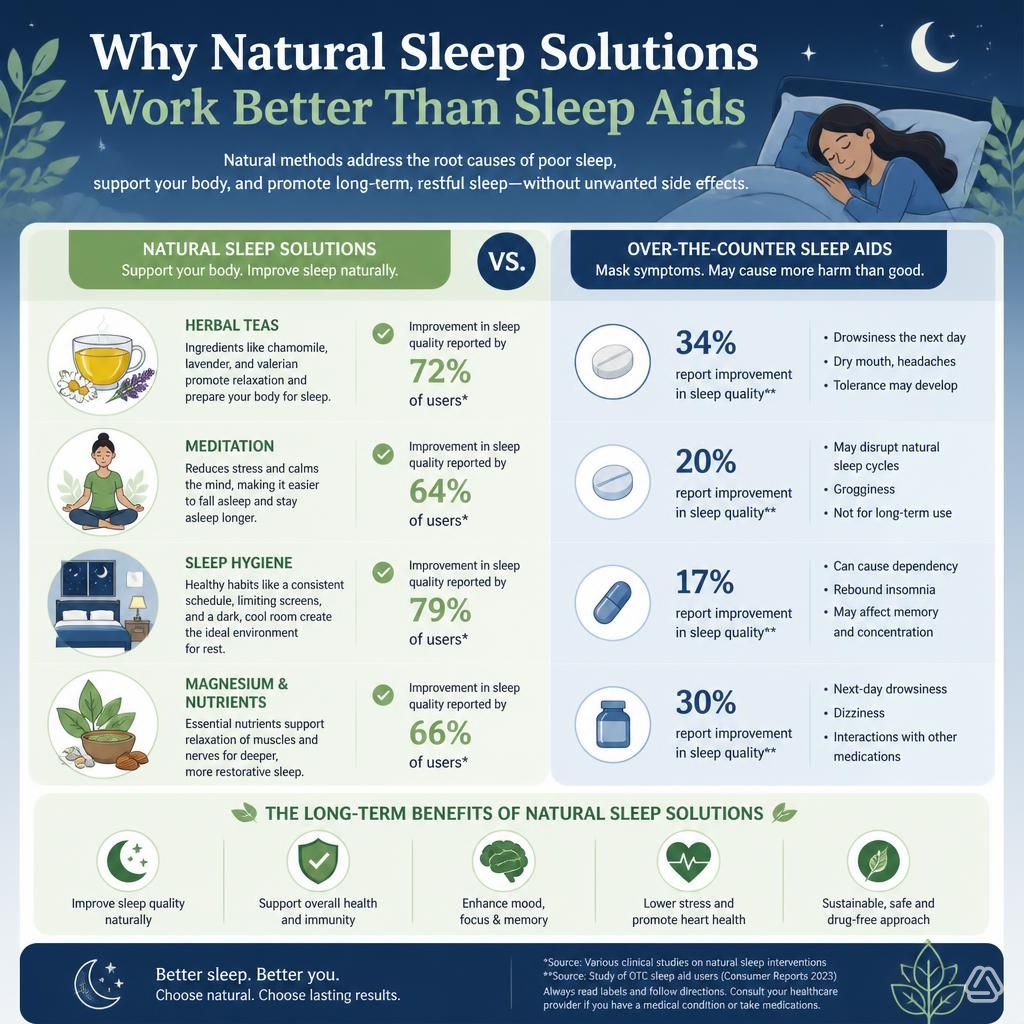
It’s tempting to reach for a sleep aid when you’re desperate for rest. But here’s what the research consistently shows: both over-the-counter and prescription sleep medications suppress REM sleep — the critical stage responsible for emotional processing, memory consolidation, and mental restoration. They may get you unconscious faster, but the sleep you get is architecturally different from natural sleep, and not in a good way.
Beyond suppressed REM, many sleep medications create dependency cycles and rebound insomnia — meaning your sleep can actually get worse when you stop using them. Crucially, they don’t address the root causes: a dysregulated circadian rhythm, depleted adenosine pressure, suppressed melatonin production, or a nervous system stuck in overdrive.
Natural approaches work differently. They help restore the biological systems that govern sleep — your internal clock, your sleep-pressure buildup, and your melatonin cycle — so that quality sleep becomes a consistent, self-sustaining outcome. Think of the following 7 strategies not as a checklist, but as an interconnected system. Each one amplifies the others.
Note: If you suspect a serious sleep disorder such as sleep apnea or clinical insomnia, please consult a qualified healthcare provider. This guide supports healthy sleep habits and is not a substitute for medical advice.
Strategy 1 — Master Your Light Environment
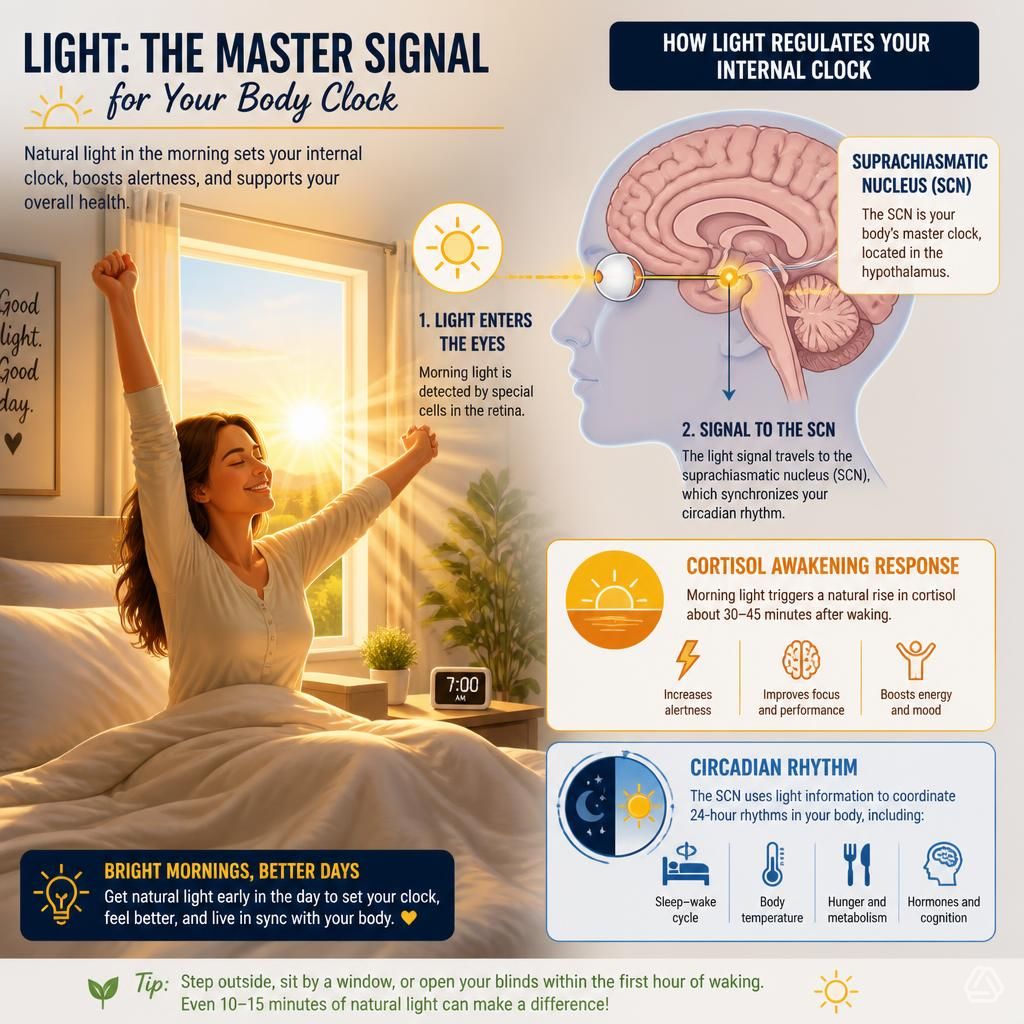
Light is the single most powerful signal your brain uses to set its internal clock. Every morning, your suprachiasmatic nucleus (the brain’s master circadian pacekeeper) is reset by light hitting your retina. This triggers the cortisol awakening response — a healthy, natural cortisol spike that promotes alertness and sets a precise countdown timer toward your next sleep window.
The prescription is beautifully simple: get 10 minutes of outdoor natural light within 30–60 minutes of waking. No sunglasses. Even on overcast days, outdoor light is 10–50 times brighter than typical indoor lighting — more than enough to anchor your clock. This one habit alone can measurably improve your sleep onset time that same night.
On the flip side, evening light is the enemy of melatonin. Research published in the Journal of Clinical Endocrinology & Metabolism — and widely cited by Harvard Health — has demonstrated that blue-spectrum light from screens can suppress melatonin production by up to 50%, delaying sleep onset and reducing overall sleep quality. Your body expects a 14–16 hour light-dark cycle aligned with natural day and night. Modern screen culture compresses that dramatically.
After 8pm, switch to warm, dim lighting. Use your device’s Night Shift or similar warm-tone mode. Consider blue-light-blocking glasses if screens are unavoidable in the evening. Your brain will take the hint — and melatonin will flow on schedule.
Strategy 2 — Keep a Consistent Sleep-Wake Schedule
If there’s one habit that sleep scientists consistently rank above all others, this is it. Dr. Matthew Walker, neuroscientist and author of Why We Sleep, identifies a fixed wake time as the single highest-leverage change most people can make. The reason comes down to two core biological systems: your circadian rhythm and your adenosine sleep drive.
Adenosine is a chemical that builds up in your brain from the moment you wake, creating increasing sleep pressure throughout the day — like a pressure valve that’s slowly tightening. When you sleep, adenosine is cleared. The system works beautifully on a consistent schedule. Disrupt it with irregular sleep and wake times, and you essentially throw the valve off rhythm.
Irregular sleep schedules cause what researchers call “social jetlag” — a term for the circadian disruption caused by sleeping in on weekends or staying up late one night and crashing the next. Studies show this can be as physiologically disruptive as crossing multiple time zones every single week. Your gut microbiome, hormone levels, and metabolism all feel it.
The fix: pick a fixed wake time and protect it — yes, even on weekends. Work backward 7–9 hours to find your target bedtime. Consistency, not just duration, determines whether you wake up genuinely restored.

Strategy 3 — Create a Wind-Down Ritual
Your nervous system cannot flip a switch from full-speed daytime mode to deep restorative sleep. It needs a transition runway — a deliberate shift from sympathetic (fight-or-flight) activation to parasympathetic (rest-and-digest) mode. Without it, you’re essentially asking your brain to go from 80mph to a full stop in seconds. It won’t cooperate.
Build a 30–45 minute pre-sleep ritual that signals your brain sleep is approaching. This might look like dimming the lights throughout your home, making a cup of chamomile or passionflower tea (both have evidence supporting mild anxiolytic effects), doing light stretching or a yoga nidra practice, or reading fiction — something that absorbs your attention without demanding problem-solving.
One of the most underrated wind-down tools is journaling a brain dump of tomorrow’s to-do list. Research has shown that this “cognitive offload” technique — writing out pending tasks before bed — significantly reduces the intrusive, planning-focused thinking that causes those dreaded 3am wake-ups. You’re essentially telling your brain: “It’s handled. You can let go now.”
Magnesium glycinate supplementation is also gaining strong support for sleep quality — it supports GABA activity, which promotes nervous system calm. That said, always check with a healthcare provider before adding any supplement to your routine. What to skip: TV in bed, social media doomscrolling, heated conversations, and bright overhead lights. All of these keep your sympathetic nervous system engaged right up to the moment you’re trying to sleep.
Strategy 4 — Optimize Your Sleep Environment
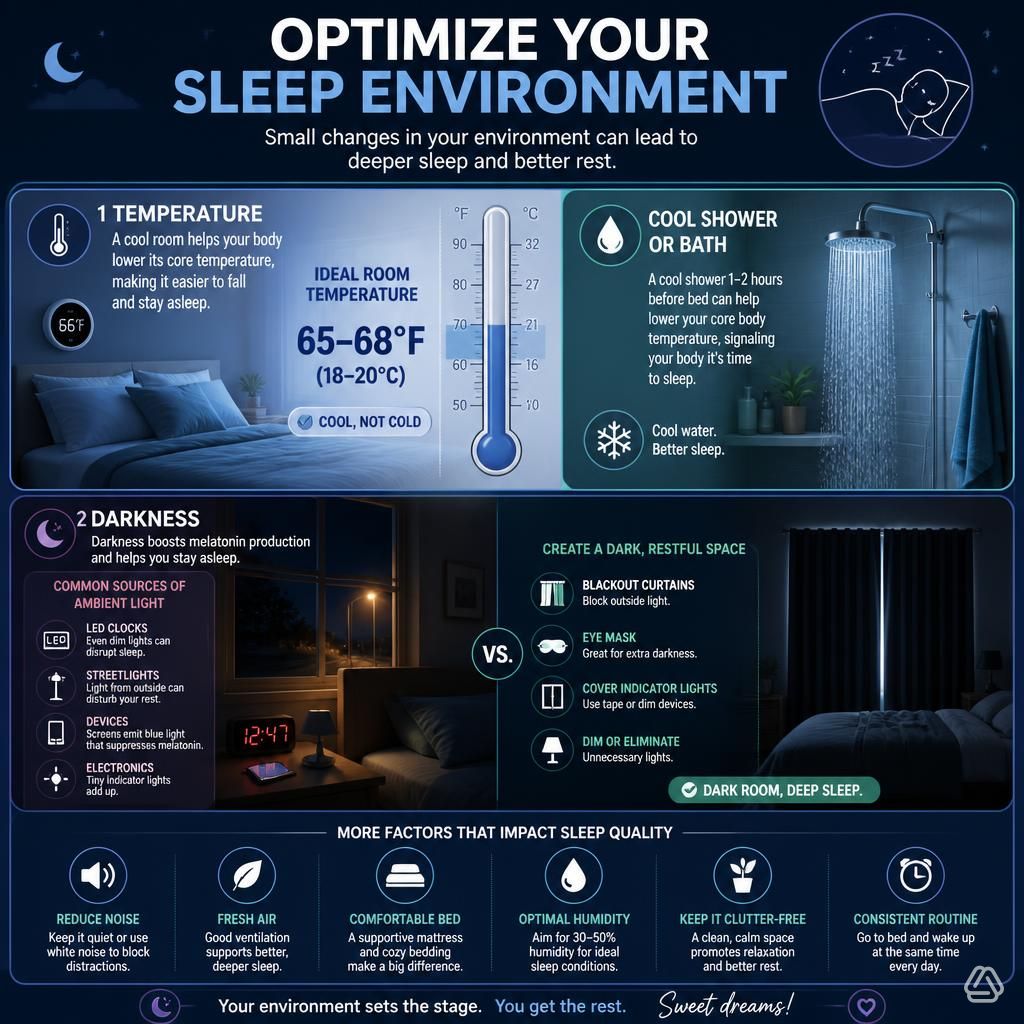
Your bedroom is either working for your sleep or against it — and most people are surprised by how much the physical environment matters. Think of your bedroom as a tool. Three factors make or break it.
Temperature is the most underestimated. Your core body temperature needs to drop by approximately 1–3°F to initiate and maintain sleep. The ideal room temperature for sleep is 65–68°F (18–20°C). If you’ve ever slept terribly in a warm hotel room, you’ve felt this principle in action. A cool shower or bath 90 minutes before bed can actually help trigger this temperature drop through the rebound cooling effect that follows.
Darkness matters more than most people realize. Even small amounts of ambient light — the glow from an LED clock, a streetlight filtering through curtain gaps, a phone screen on standby — can signal the brain to suppress melatonin. Blackout curtains are one of the highest-ROI sleep investments you can make. A quality sleep mask is a close second for travel or rentals.
Sound is the third lever. Research on pink noise and brown noise has found that consistent ambient sound can mask disruptive environmental spikes (traffic, neighbors, partners) and actually promote slow-wave deep sleep. A simple white noise machine, a fan, or a nature sounds app can make a measurable difference — especially if you live in an urban environment like a busy city neighborhood.
Strategy 5 — Watch What (and When) You Eat and Drink
What’s on your plate — and when it’s there — has a direct line to your sleep quality. Large meals within 2–3 hours of bedtime raise your core body temperature and spike metabolic activity at exactly the wrong time, making it harder to fall asleep and easier to wake during the night.
Caffeine deserves special attention. Caffeine has a half-life of 5–6 hours — meaning that afternoon coffee at 3pm still has half its stimulant effect circulating in your system at 9pm, according to research highlighted by Dr. Matthew Walker. For sensitive individuals, that effect lingers even longer. Cutting off caffeine by noon or 1pm is a simple, high-impact change.
Alcohol is perhaps the most widely misunderstood sleep saboteur. It feels like a sedative — and it is, in the short term — but alcohol fragments sleep architecture and actively suppresses REM sleep, robbing you of the most cognitively restorative sleep stage. You may fall asleep faster, but you’ll wake more often and feel less restored.
On the supportive side, certain foods genuinely help. Tart cherry juice is one of the only natural food sources of melatonin. Kiwi has been studied for its serotonin-precursor content, with one small trial showing it improved sleep onset and duration. Turkey, eggs, and bananas provide tryptophan and the B6 needed to convert it into serotonin and ultimately melatonin. Staying well-hydrated during the day also prevents thirst-triggered wake-ups at night — just taper fluids in the 1–2 hours before bed.
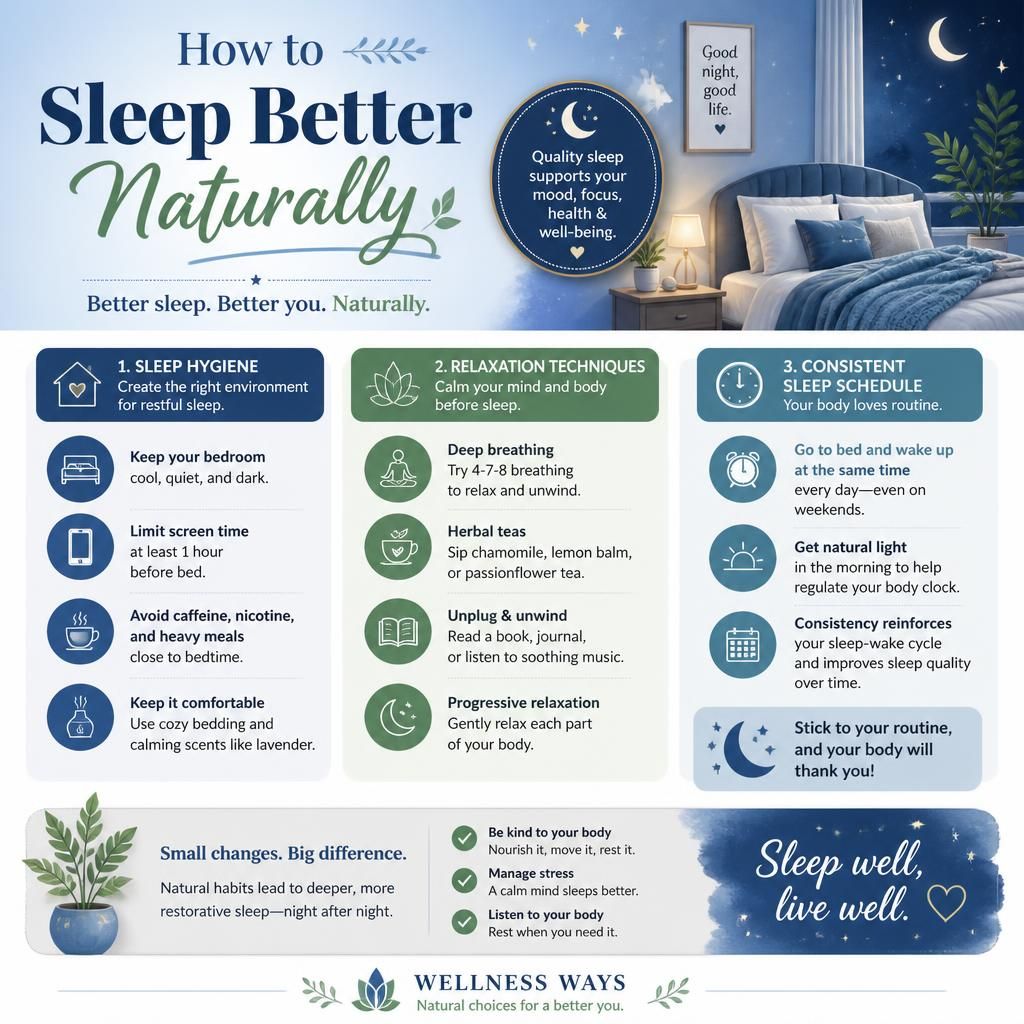
Restorative sleep is the foundation every other health goal is built on. Here’s how to get there — naturally.
Strategy 6 — Move Your Body, But Time It Right
Regular physical activity is one of the most robustly proven natural sleep remedies in the literature. Even 20–30 minutes of moderate daily movement measurably improves sleep onset time, increases slow-wave (deep) sleep duration, and reduces nighttime awakenings. Studies specifically on exercise and slow-wave sleep have found that aerobic exercise is particularly effective at boosting the deepest, most physically restorative sleep stage.
The timing caveat is important, though. Intense exercise within 2–3 hours of bedtime can delay sleep onset by elevating cortisol and raising core body temperature — the opposite of what you need. Morning or early afternoon workouts get you all the sleep benefits without the interference. If evenings are your only window, keep it light — a walk, gentle yoga, or stretching rather than a hard training session.
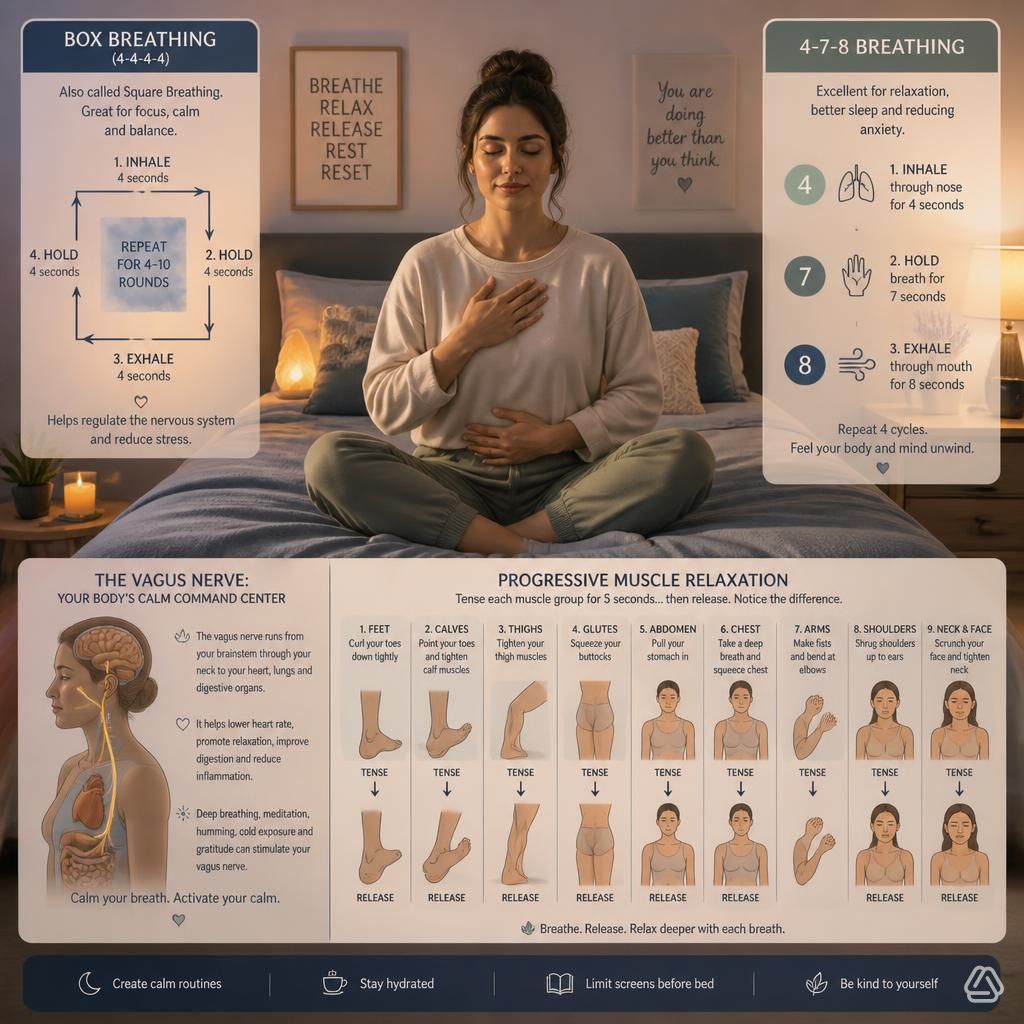
Strategy 7 — Address Stress and Anxiety at the Root
For most adults, stress-triggered cortisol is the number one enemy of good sleep. When your brain perceives threat — and modern life delivers threats in the form of deadlines, financial pressure, relationship tension, and 24-hour news — the amygdala stays hyperactivated. This keeps your nervous system in a state of low-grade alert that directly blocks the parasympathetic shift required for deep sleep to begin.
The good news is that the nervous system is remarkably responsive to deliberate regulation techniques. Box breathing (inhale 4 counts, hold 4, exhale 4, hold 4) and the 4-7-8 breathing method (inhale 4, hold 7, exhale 8) both activate the vagus nerve and measurably shift the autonomic nervous system toward calm within minutes. Progressive muscle relaxation — systematically tensing and releasing muscle groups from feet to face — is another evidence-supported technique for reducing pre-sleep arousal.
Keeping a “worry journal” before bed — a dedicated space to write out anxious thoughts and assign them a time to deal with tomorrow — takes the pressure off your brain to “hold” those concerns through the night. It’s the same cognitive offload principle as the to-do brain dump, applied specifically to anxiety.
One more reason this isn’t optional: chronic stress physically remodels the brain, shrinking the hippocampus — the region central to memory and emotional regulation — over time. Addressing stress at the root isn’t just about better nights. It’s about protecting your long-term cognitive health. For a deeper dive on this, check out the WellnessWays article on how chronic stress affects your brain.
Your 7-Strategy Natural Sleep System at a Glance
Here’s your complete restorative sleep blueprint — science-backed, natural, and ready to implement tonight:
📋 The WellnessWays Natural Sleep System
- Master Your Light Environment — Morning sunlight anchors your clock; dim, warm light after 8pm protects melatonin.
- Keep a Consistent Sleep-Wake Schedule — A fixed wake time (including weekends) is the single most powerful sleep habit you can build.
- Create a Wind-Down Ritual — Give your nervous system a 30–45 minute runway from “on” to “off” each night.
- Optimize Your Sleep Environment — Cool (65–68°F), dark, and quiet. These three conditions are non-negotiable for deep sleep.
- Watch What and When You Eat and Drink — Cut caffeine by early afternoon, avoid late large meals, skip the nightcap, and add sleep-supportive foods.
- Move Your Body — in the Morning or Afternoon — 20–30 minutes of daily moderate exercise boosts deep sleep; time it at least 2–3 hours before bed.
- Address Stress and Anxiety at the Root — Breathing techniques, worry journaling, and progressive muscle relaxation shift your nervous system out of threat mode so sleep can begin.

Start Tonight — One Strategy at a Time
Here’s what we want you to hold onto: restorative sleep is the foundation that everything else is built on. Your nutrition, your fitness, your mental sharpness, your emotional resilience, your longevity — all of it is downstream of how well you sleep. This isn’t a wellness nice-to-have. It’s the cornerstone.
But here’s the thing — you don’t need to implement all 7 strategies tonight. That’s not how sustainable change works, and it’s not what we’re asking. Read through the list and pick the two strategies that resonate most with where your sleep is breaking down right now. Practice those two deliberately for a full week. Notice what shifts. Then stack in the next one.
The compounding effect is real. Each strategy you build reinforces the ones around it. Within a few weeks, you’ll likely find that falling asleep faster, staying asleep longer, and waking up genuinely refreshed has stopped feeling like a distant goal — and started feeling like your new normal.
You deserve that kind of rest. Your brain, your body, and everyone around you will feel the difference.
Share this guide with someone in your life who’s struggling with sleep — it might be exactly what they need. And when you’re ready to go deeper, WellnessWays has you covered on every layer of the wellness foundation.
📚 Continue Reading on WellnessWays
Related Posts — Explore the Full Wellness Foundation:
- The Ultimate Morning Routine for Brain Clarity — Build on better sleep with a morning structure that sharpens focus and sets the tone for your entire day.
- How Chronic Stress Affects Your Brain — Understand the neuroscience of stress and why addressing it is essential for long-term cognitive health.
- Best Supplements for Mental Clarity — Evidence-based guidance on the supplements worth considering — and the ones not worth your money.
Not sure what’s causing your brain fog? Take our free 3-minute Root Cause Quiz and get your personalized action plan! → [Take The Quiz]
This article is for informational and educational purposes only. It is not intended as medical advice. Always consult a qualified healthcare professional for diagnosis and treatment of sleep disorders or any health concern.