
The Brain Plasticity Guide: Neuroplasticity Brain Rewiring – How Your Brain Rewires Itself
Introduction
For most of the twentieth century, neuroscientists believed that the adult brain was essentially fixed. You were born with a certain number of neurons, you gradually lost them as you aged, and there was very little you could do about it.
That understanding was wrong.
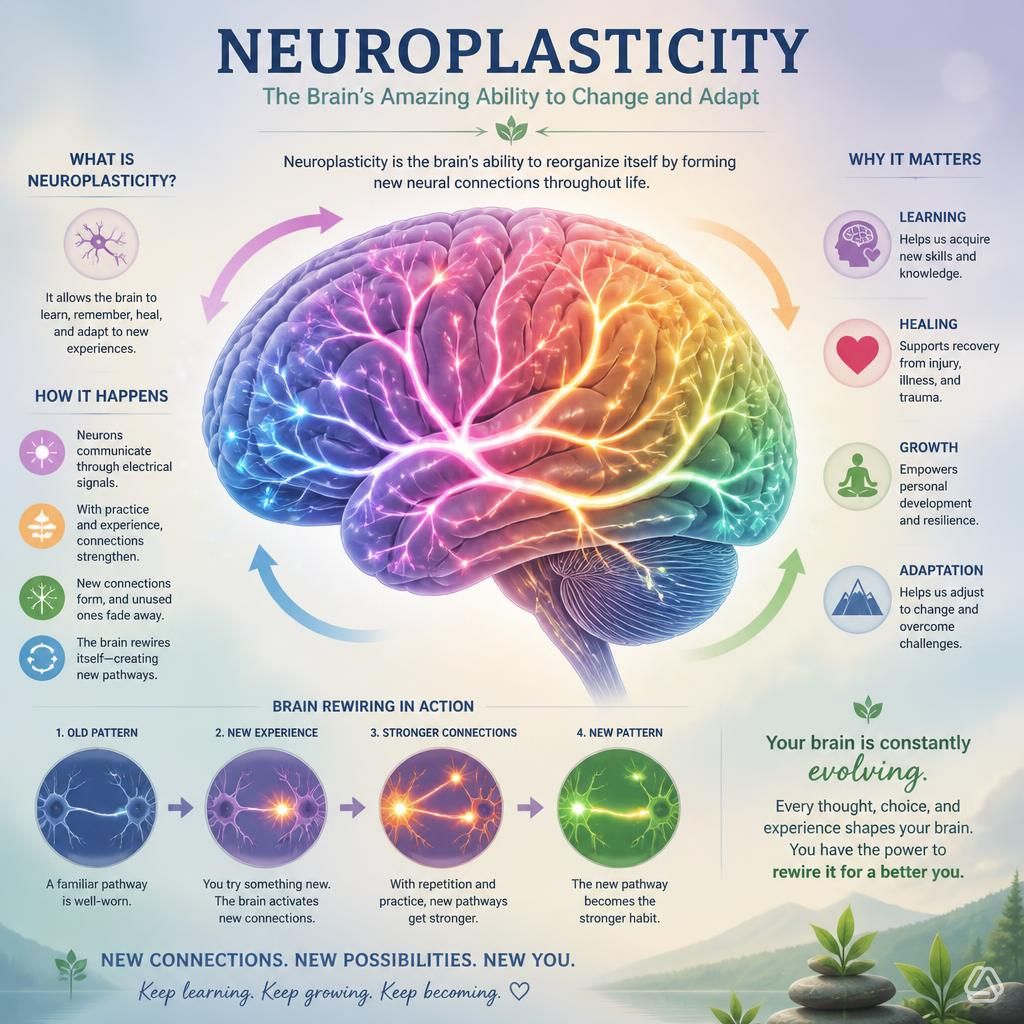
The modern science of neuroplasticity — the brain’s ability to reorganize itself by forming new neural connections throughout life — has fundamentally transformed how we understand the human brain. And the implications are enormous.
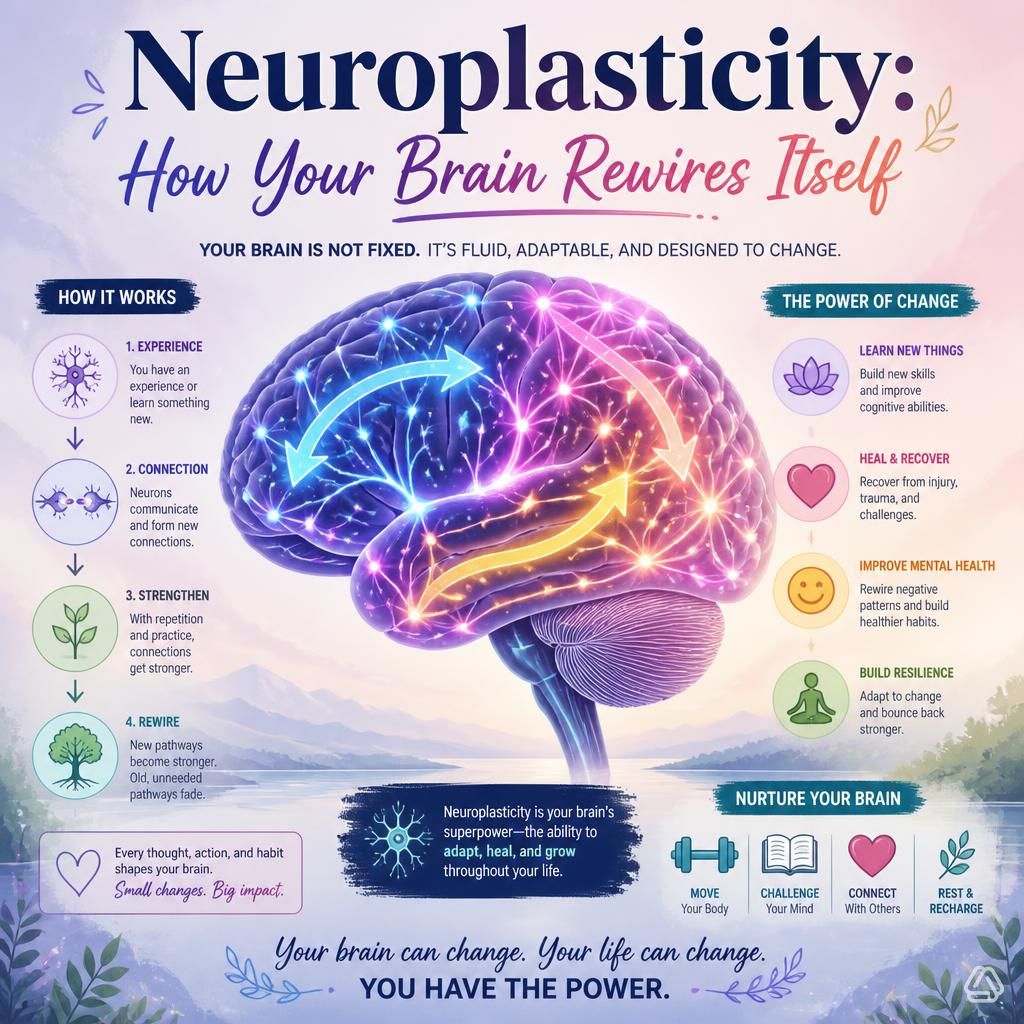
Your brain is not a static organ slowly declining toward obsolescence. It is a dynamic, responsive, continuously remodeling system that changes in structure and function based on how you use it, what you experience, what you eat, how you sleep, and how you move.
This guide covers the science of neuroplasticity in practical depth: what it is, how it works, what drives it, and how you can harness it — at any age.
What Is Neuroplasticity?
Neuroplasticity — also called brain plasticity or neural plasticity — is the umbrella term for the brain’s capacity to change its own structure and function in response to experience, learning, injury, or environmental input.
The term comes from “neuron” (brain cell) and “plastic” — meaning moldable or changeable. The brain is, quite literally, moldable.
Neuroplasticity encompasses several distinct biological processes:
Synaptic plasticity — the strengthening or weakening of connections (synapses) between existing neurons based on how frequently they communicate. Neurons that fire together, wire together — this is the foundational principle of learning and memory.
Structural plasticity — physical changes in the size, shape, and density of neurons and brain regions. Regular mental or physical activity causes measurable structural changes in the brain visible on MRI scans.
Neurogenesis — the birth of brand new neurons. This was the most controversial discovery in neuroscience: the adult brain can grow new neurons — primarily in the hippocampus (memory center) and olfactory bulb. This process continues throughout life, though it slows with age and is significantly influenced by lifestyle factors.
Cortical remapping — the brain’s ability to reassign functions from damaged areas to healthy ones, which underlies recovery from strokes, brain injuries, and neurological conditions.
The History: From Fixed to Flexible
The story of how science came to understand neuroplasticity is a story of overturning deeply held assumptions.
In the 1960s, neuroscientist Michael Merzenich conducted experiments showing that the brain’s sensory cortex reorganizes itself in response to changes in sensory input. When an area of the cortex stopped receiving input — after amputation, for example — adjacent brain areas quickly colonized that cortical territory.
In the 1990s, Eleanor Maguire at University College London scanned the brains of London taxi drivers and found that their hippocampi — the brain structures responsible for spatial navigation — were measurably larger than those of non-taxi drivers. The more years of driving experience, the larger the hippocampus. The brain had physically grown in response to sustained use.
And in 1998, Peter Eriksson published a study in Nature Medicine confirming that the adult human brain grows new neurons in the hippocampus — directly contradicting the long-held dogma that neurogenesis ends at birth.
The evidence accumulated rapidly. The scientific consensus shifted. The adult brain is not fixed. It is continuously remodeling.
BDNF — The Brain’s Most Important Growth Factor
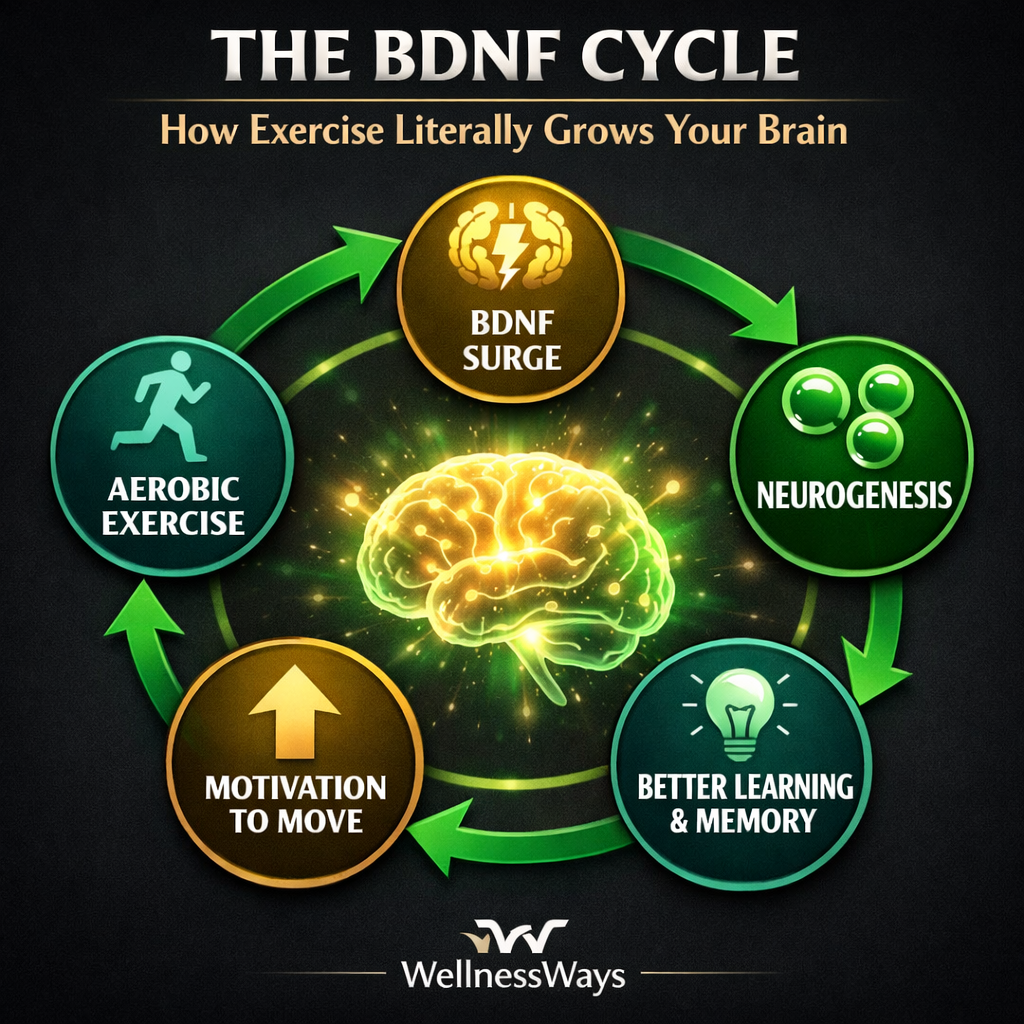
At the heart of neuroplasticity is a protein called Brain-Derived Neurotrophic Factor — BDNF.
BDNF is often described as “fertilizer for the brain.” It:
- Promotes the survival and growth of existing neurons
- Drives the formation of new synaptic connections
- Stimulates neurogenesis in the hippocampus
- Supports the consolidation of new learning into long-term memory
- Protects neurons from stress and injury
Low BDNF levels are associated with depression, anxiety, cognitive decline, Alzheimer’s disease, and reduced learning capacity. High BDNF levels are associated with sharper memory, faster learning, more positive mood, and greater cognitive resilience.
The most powerful known stimulator of BDNF? Aerobic exercise. A single session of moderate-to-vigorous aerobic exercise can double BDNF levels in the bloodstream. This is the neurobiological explanation for the cognitive sharpness you feel after a good workout.
What Grows Your Brain — The Neuroplasticity Accelerators
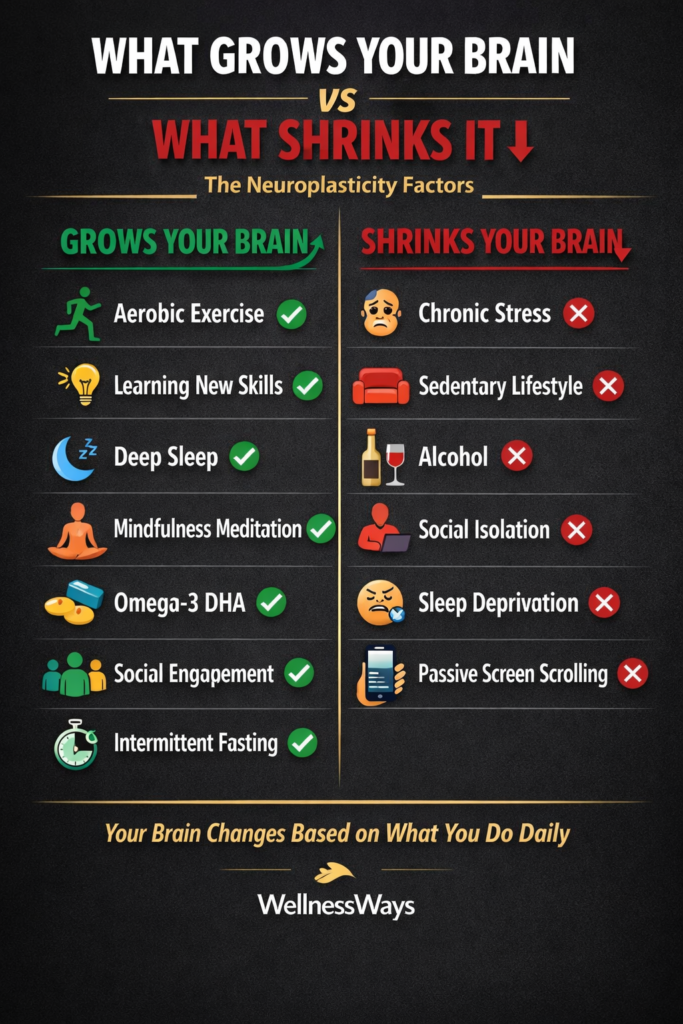
1. Aerobic Exercise
The single most powerful neuroplasticity tool available to you. A 2011 study by Kirk Erickson at the University of Pittsburgh randomized older adults to either aerobic exercise or stretching for one year. The aerobic exercise group showed a two percent increase in hippocampal volume — effectively reversing one to two years of age-related brain shrinkage. The stretching group showed a one-point-four percent decline.
A two percent increase in hippocampal volume. From walking. For a year.
Target: 150 minutes of moderate aerobic activity per week — brisk walking, cycling, swimming, or any activity that elevates your heart rate to 60 to 70 percent of maximum.
2. Learning New Skills
Neuroplasticity is activity-dependent. The brain rewires itself around what you repeatedly do and experience. Learning a new skill — a musical instrument, a language, a craft, a sport — forces the brain to form new neural pathways and strengthen existing ones.
The key word is new. Repeating skills you already have does not drive the same degree of plasticity. Challenge is the trigger. Novelty is the signal.
3. Deep, Quality Sleep
During slow-wave sleep, the brain consolidates newly formed neural pathways into stable, long-term structures. This is when the day’s learning gets “wired in.”
Sleep deprivation does not merely make you tired — it prevents the neuroplastic changes from learning from consolidating. What you learn while sleep-deprived is less likely to stick. And chronic sleep loss causes measurable loss of dendritic spines — the microscopic structures that form synaptic connections.

4. Mindfulness Meditation
A 2011 study from Harvard found that eight weeks of mindfulness meditation produced measurable increases in cortical thickness in the prefrontal cortex, hippocampus, and posterior cingulate cortex — areas associated with learning, memory, and self-awareness.
The practice does not need to be long. Research suggests as little as ten to twenty minutes of daily mindfulness practice produces detectable structural changes within eight weeks.
5. Intermittent Fasting
Emerging research suggests that intermittent fasting significantly elevates BDNF levels. During fasting states, the brain undergoes mild metabolic stress that appears to stimulate neuroplastic adaptation — a process analogous to how muscles grow stronger in response to exercise stress.
A 16:8 fasting pattern (16 hours fasted, 8 hour eating window) is the most commonly studied and practically manageable approach.
6. Social Engagement
Meaningful social interaction is consistently associated with better cognitive aging outcomes. Socially engaged individuals show larger brain volumes in prefrontal and temporal regions in late life.
The neurobiological mechanism involves the complex cognitive demands of social interaction — theory of mind, emotional interpretation, language, memory — all of which continuously challenge and stimulate the brain’s plasticity mechanisms.
7. Omega-3 Fatty Acids (DHA)
DHA is a structural component of neuronal membranes and is directly involved in synaptic plasticity. Studies show that adequate DHA intake supports BDNF production and synaptic membrane fluidity — the flexibility of the connections that learning depends on.
What Shrinks Your Brain — The Neuroplasticity Inhibitors
Understanding what harms neuroplasticity is as important as knowing what supports it.
Chronic stress and high cortisol directly suppress BDNF production and inhibit neurogenesis in the hippocampus. Prolonged stress exposure causes measurable hippocampal volume loss.
Chronic alcohol use reduces BDNF, impairs synaptic plasticity, and accelerates neuronal loss across multiple brain regions.
Sedentary lifestyle is consistently associated with reduced hippocampal volume and lower BDNF levels. Movement is not optional for brain health.
Social isolation is associated with accelerated cognitive decline and reduced brain volumes — particularly in prefrontal regions — in multiple longitudinal studies.
Chronic sleep deprivation prevents memory consolidation and degrades the synaptic structures formed during learning.
Excessive passive screen time — scrolling, passive video consumption — activates the brain’s reward circuitry without generating the cognitive challenge needed to drive neuroplastic adaptation. It strengthens the distraction pathway while the focus pathway goes unstimulated and weakens.
Neuroplasticity Across the Lifespan
Neuroplasticity is not uniform across life. It is highest during critical developmental periods in childhood and adolescence — sometimes called sensitive periods — when the brain is most rapidly organizing itself around experience.
But the adult brain retains significant plasticity throughout life. The rate of change is slower — but the capacity is present. This is the crucial insight.
Studies show measurable neuroplastic changes in adults in their 60s, 70s, and 80s in response to exercise, learning, and lifestyle interventions. The brain does not become fixed at 25 or 40 or 60. The window never fully closes.
What changes with age is the efficiency of plasticity — it requires more sustained effort and more time to produce the same magnitude of structural change. But the mechanism remains intact.
Practical Neuroplasticity Protocol — Start This Week
| Day | Action | Brain Benefit |
|---|---|---|
| Monday | 30-min brisk walk | BDNF surge, hippocampal stimulation |
| Tuesday | Learn 5 new vocabulary words | Synaptic formation, language network |
| Wednesday | 30-min brisk walk + 10-min meditation | Combined BDNF + cortical thickening |
| Thursday | Try one completely new activity | Novelty-driven plasticity |
| Friday | 30-min brisk walk | Sustained BDNF elevation |
| Saturday | Social engagement — meaningful conversation | Prefrontal stimulation |
| Sunday | Prioritize 8 hours of sleep | Consolidation, synaptic maintenance |
Conclusion
Your brain is not a fixed structure waiting to decline. It is a living, responsive, continuously adapting organ that changes with every experience, every challenge, and every choice you make.
Neuroplasticity means that it is never too late to build a sharper, more resilient brain. It means that the damage from years of stress or poor sleep can — with time and the right inputs — be reversed. It means that who you are cognitively today is not who you have to be tomorrow.

The science is not motivational language. It is biology. Your brain is built to change.
The question is only: what are you changing it into?
Ready to learn more? [Read our Glymphatic System guide to understand how sleep consolidates your brain’s plasticity gains →] | [Explore our Best Supplements for Mental Clarity for evidence-based neuroplasticity support →]
Disclaimer: This article is for informational purposes only and does not constitute medical advice. Consult a qualified healthcare professional before making changes to your health routine.
Not sure what’s causing your brain fog? Take our free 3-minute Root Cause Quiz and get your personalized action plan! → [Take The Quiz]