
The 10-Minute Morning Routine for Busy People (That Actually Works)
You’ve seen the 5am, two-hour morning routines all over social media. Journaling, cold plunge, sauna, meditation, gym session, green juice — and you’re standing there thinking, “Great for them, but I have kids, a job, and an actual life.” Here’s the truth: you don’t need two hours to transform how your brain and body feel each morning. You need 10 intentional minutes. Built on the same neuroscience as those marathon routines, this streamlined version targets the three highest-leverage biological levers your body has — and you can complete all of it before your first cup of coffee.
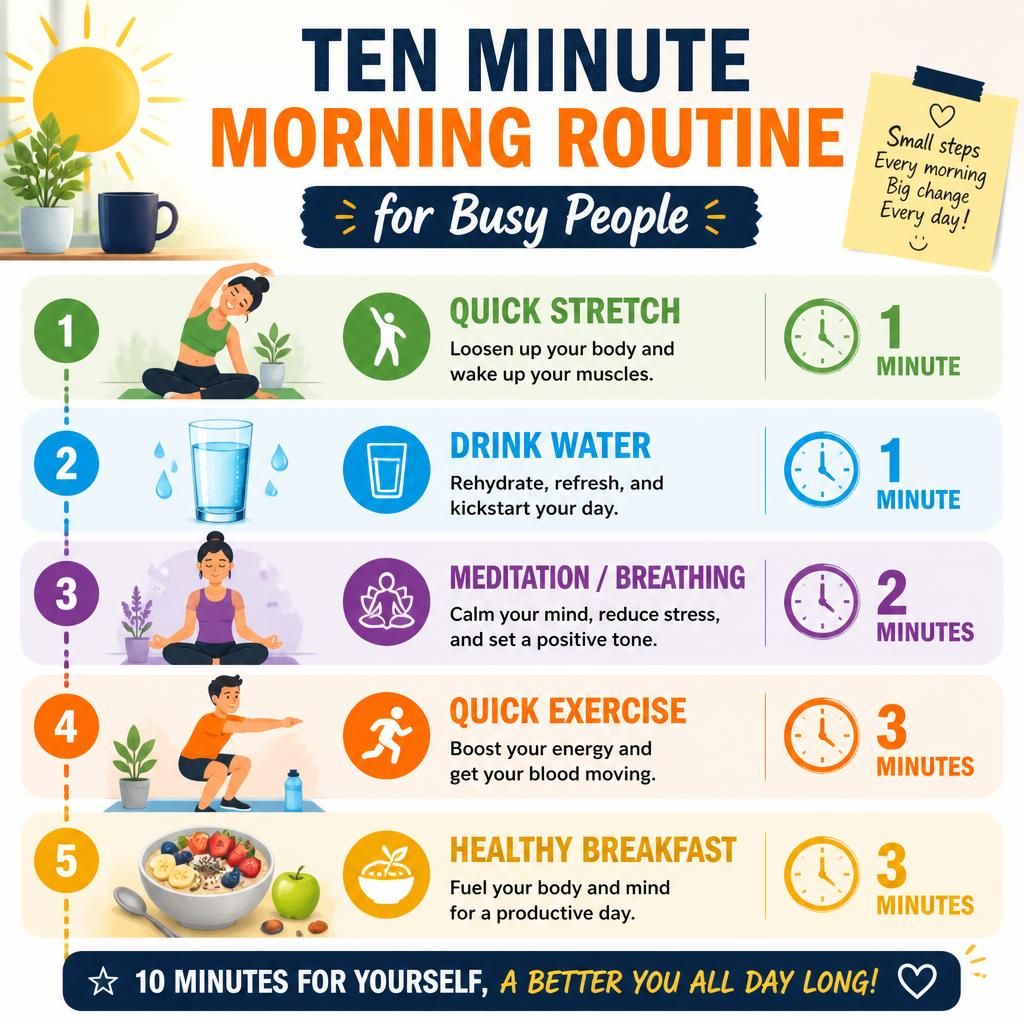
Why Just 10 Minutes Is Enough
The most impactful morning habits work not because of their length, but because of their timing and biological effect. In the first hour after waking, three things matter most: hydration (your brain is measurably dehydrated after sleep), light exposure (which sets your circadian clock for the entire day), and movement (which triggers BDNF and clears residual adenosine — the chemical that makes you feel groggy). Everything else — the journaling, the cold plunge, the hour of breathwork — is an enhancement. Not a requirement.
These three fundamentals take fewer than 10 minutes and create the neurochemical foundation for a sharp, focused day. Here’s what you’re racing against: the cortisol awakening response, a natural alertness window that opens in the first 30–45 minutes after waking. Most people accidentally squander it by reaching straight for their phone. This routine uses it instead.
Minute 1 — Water First, Phone Second
Before anything else — before coffee, before your phone, before you say a single word — drink 12–16 oz of water. After 7–8 hours without fluid intake, even mild dehydration measurably impairs cognitive performance, mood, and reaction time. Your brain needs water before it can do anything else well.
Make this effortless: keep a full glass or water bottle on your nightstand the night before so it requires zero willpower in the morning. If you want to go next level, add a small pinch of sea salt and a squeeze of lemon — the electrolytes help your body absorb the water faster. Clock this at 60 seconds flat, and you’ve already done something meaningful for your brain.

Minutes 2–4 — Light and Air
Step outside — even just to your porch, balcony, or front doorstep — for 2–3 minutes of morning light exposure. This single act triggers the suprachiasmatic nucleus, your brain’s master circadian clock, to release the cortisol awakening response in full force. The result: you feel more alert faster, concentrate better throughout the day, and sleep more deeply that night.
On overcast mornings — and if you’re in a place like Portland (Oregon or Maine), you know those well — stay out a couple of minutes longer. Even diffuse, cloudy light delivers enough photons to trigger the circadian signal. Leave your sunglasses off during this window. If stepping outside truly isn’t an option, stand directly at a bright, sun-facing window. Neuroscientist Andrew Huberman has called this habit one of the highest-leverage, zero-cost brain optimization tools available — and it takes less time than brewing your coffee.
Minutes 5–8 — Move for 3–4 Minutes
You don’t need a gym, equipment, or even workout clothes for this one. Three to four minutes of any movement that raises your heart rate — jumping jacks, a brisk walk to the end of your street and back, a few sets of bodyweight squats and push-ups, or even dancing in your kitchen — is enough to trigger the release of BDNF (brain-derived neurotrophic factor).
BDNF accelerates neural connections, sharpens working memory, and measurably improves your focus for the next two to four hours. Think of it as turning on your brain’s engine before you try to drive it anywhere. Research published in the Journal of Clinical and Experimental Neuropsychology shows that even brief moderate exercise significantly improves executive function and sustained attention. You don’t need an hour. You need three minutes and a willingness to move.
Minutes 9–10 — Set Your One Thing
Before you open email, check the news, or scroll social media, spend the final 90 seconds identifying your single most important outcome for today. Not a to-do list — a specific, singular intention. “I will finish the client proposal by noon.” “I will have a focused, prepared conversation with my team at 2pm.” Write it down, even if it’s just on a sticky note.
This small act engages your prefrontal cortex in a structured, proactive mode rather than allowing it to immediately enter reactive mode — which is exactly what happens the moment you open your inbox. Intention-setting has been shown to reduce decision fatigue, lower morning anxiety, and improve task completion rates throughout the day. It costs you 90 seconds. It pays dividends for hours.

The Full 10-Minute Schedule at a Glance
Here’s exactly what your morning looks like — simple, sequential, and completely doable even on your most chaotic days.
Minute 1 — Drink 12–16 oz of water from the bottle you placed on your nightstand the night before. Phone stays face-down.
Minutes 2–4 — Step outside or stand at a bright window for 2–3 minutes of natural light exposure. No sunglasses. Breathe.
Minutes 5–8 — Do 3–4 minutes of any heart-rate-raising movement — jumping jacks, push-ups, a brisk walk, a kitchen dance break. Anything counts.
Minutes 9–10 — Write down your one most important intention for the day. One sentence. One outcome. Done.
That’s it. Four steps. Ten minutes. A neurochemically primed brain ready to take on your day.
Start Tomorrow — Just 7 Days
This isn’t the ceiling — it’s the foundation. You don’t have to overhaul your mornings overnight. Start with just these 10 minutes for seven consecutive days and pay attention to how your morning energy and mental clarity shift. When it feels easy and automatic — and it will — you can begin layering in whatever extras resonate with you. Maybe that’s five minutes of journaling. Maybe it’s a longer walk. The goal was never a perfect routine. The goal is a repeatable one.
Ready to go deeper? For a full, science-backed breakdown of building the ultimate morning for brain clarity, read our complete guide on the WellnessWays blog. And if you know a busy friend or colleague who’s been telling themselves they don’t have time for a morning routine, do them a favor — share this article with them today. Ten minutes could change their entire day.
Additional supporting information:
The Ultimate Morning Routine for Brain Clarity
Not sure what’s causing your brain fog? Take our free 3-minute Root Cause Quiz and get your personalized action plan! → [Take The Quiz]