
How Dehydration Affects Your Brain (And Why You’re Probably Not Drinking Enough)
Science-backed strategies for sharper thinking, steadier energy, and better focus — starting with your next glass of water.
Picture this: it’s mid-afternoon, everything feels foggy, your thoughts are sluggish, and your mood has quietly turned irritable for no obvious reason. You reach for a coffee. Sound familiar? Here’s the thing — you may have been solving the wrong problem entirely.
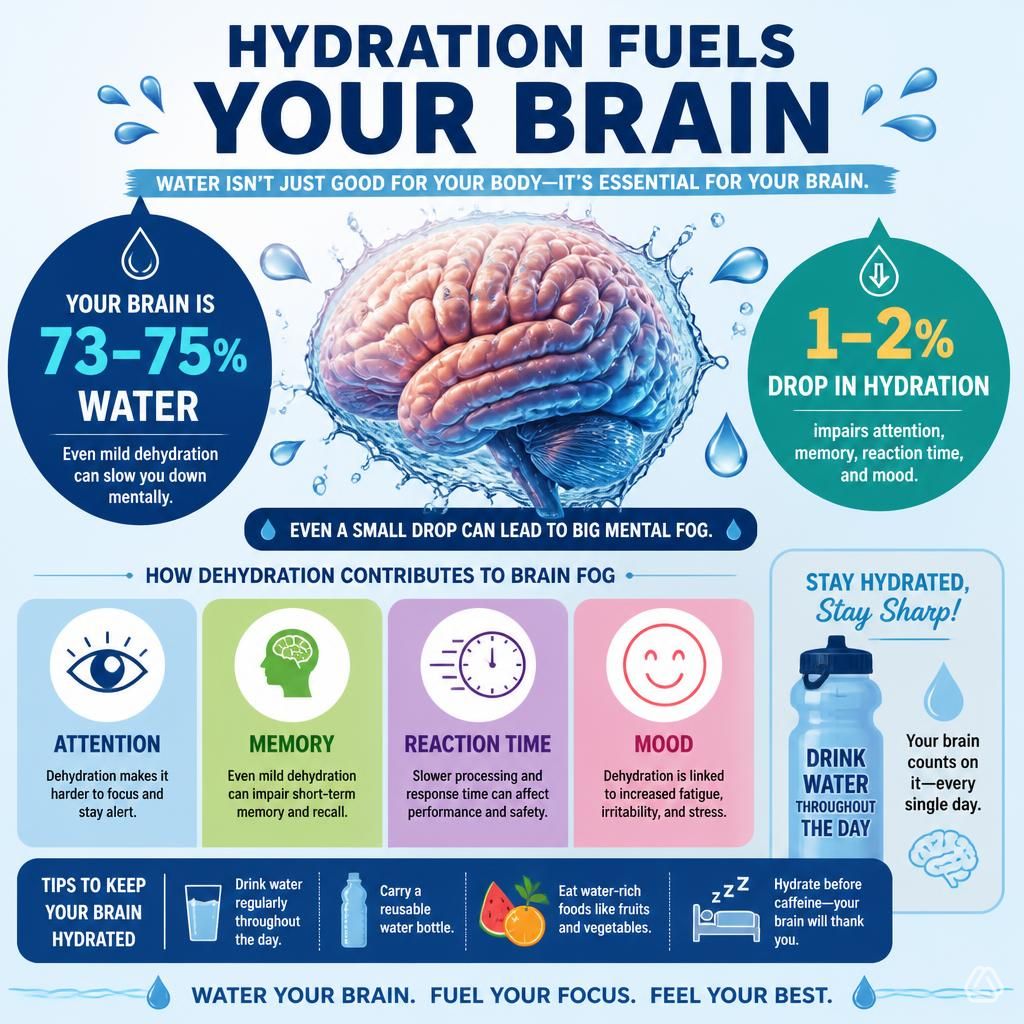
Your brain is 73–75% water. Even a 1–2% drop in your body’s hydration level — an amount far too small to trigger thirst in most people — measurably impairs your attention, working memory, reaction time, and mood. What so many of us call “brain fog” is, at its root, frequently a hydration problem. This post breaks down exactly what happens inside your brain when you’re under-hydrated, how to recognize the signs, and how to build a simple daily system that actually keeps you functioning at your best.
What Happens in Your Brain When You’re Dehydrated
This isn’t just a metaphor — dehydration causes your brain to physically change. MRI studies have confirmed that even mild dehydration produces measurable shrinkage in brain volume, most prominently in temporal and parietal areas. As brain tissue pulls slightly away from the surrounding meningeal tissue that cushions and protects it, tension builds — which is one well-documented physiological cause of those familiar dehydration headaches that tend to creep in during the afternoon.
At the cellular level, neuronal signaling slows because the electrical impulses your brain relies on depend directly on electrolyte concentrations in the fluid between cells. When that fluid drops, the sodium-potassium pump — the mechanism that drives every single nerve signal in your body — becomes less efficient. Your thoughts literally travel more slowly. The choroid plexus, which produces the cerebrospinal fluid that bathes and protects your brain, also reduces its output under dehydration, further compromising the brain’s environment.
The cognitive and emotional consequences are well-documented: slower processing speed, reduced short-term memory capacity, impaired concentration, increased anxiety, irritability, and fatigue — all measurable at just 1–2% dehydration. And here’s the part most people don’t know: your thirst reflex doesn’t kick in until you’re already 2–3% dehydrated. By the time your body is asking for water, your brain has already been running below capacity for a while.
A poor night’s sleep and dehydration produce overlapping symptoms
The Signs You’re Under-Hydrated (That Aren’t Just Thirst)
Most of us can spot the obvious signs of dehydration — a dry mouth, feeling parched after exercise. But the subtler, everyday signals are the ones we almost always misattribute to something else entirely.
That afternoon energy crash that feels like a productivity cliff? It’s not just the post-lunch slump or a poor night’s sleep — it’s frequently your brain flagging a fluid deficit that built up over the course of the morning. Similarly, if you’re finding it hard to stay on task, re-reading the same paragraph, or losing your train of thought mid-sentence, dehydration and cognitive drag may be the culprit more often than you’d expect.
Tension headaches — especially those that appear in the late morning or mid-afternoon — are a classic under-hydration signal that most people reach for ibuprofen to fix, when a large glass of water might work just as well. Unexplained irritability or a low-grade sense of anxiety with no clear emotional trigger is another one. Your mood is directly regulated by neurochemistry, and neurochemistry runs on adequate hydration.
Pay attention to your body’s physical cues too: dry or cracked lips, and dark yellow urine are reliable, no-tech indicators that you’re behind on fluids. And here’s an interesting one — craving sweets in the afternoon is frequently a hydration signal. When the brain can’t process energy efficiently due to poor hydration, it reaches for the fastest fuel source it knows: glucose. That 3pm cookie craving might be your brain asking for water, not sugar.
The 1–2% Problem — Why You’re More Dehydrated Than You Think
The honest truth is that most people operate in a state of chronic, low-grade dehydration — and have no idea. We’ve been taught to drink when we’re thirsty, but as you now know, thirst is a lagging indicator. By the time it fires, cognitive impairment has already quietly set in.
Coffee and caffeinated beverages — the morning staples for millions of people — have a mild diuretic effect, meaning they partially offset their own hydration value. They’re not the enemy, but relying on them as your primary fluid source throughout the day means you’re running a quiet hydration deficit almost by design. Add to that the effects of air conditioning, artificial heating, and sedentary indoor environments: your body loses fluid constantly through respiration and skin evaporation, even when you’re not visibly sweating.
Many people also assume they’re hydrating adequately because they consume fluids throughout the day — but studies suggest that a significant portion of daily fluid intake comes from food and non-water beverages, leaving a real gap between perceived and actual hydration. The baseline recommendation from the National Academies of Medicine is approximately 3.7 liters (125 oz) for men and 2.7 liters (91 oz) for women per day, from all sources combined. That number is almost certainly higher than what most people are actually hitting.
| Dehydration Level | What Your Brain Experiences |
|---|---|
| 1–2% fluid loss | Reduced attention, impaired short-term memory, slower reaction time, mood changes — thirst not yet triggered |
| 2–3% fluid loss | Thirst kicks in; headaches likely; significant drop in cognitive performance and physical endurance |
| 3–5% fluid loss | Severe fatigue, muscle cramps, difficulty concentrating; heat exhaustion risk increases |
How to Build a Hydration System That Actually Works
Knowing dehydration hurts your brain is one thing. Building the daily habits to prevent it is another. Here’s a simple, practical system you can start tomorrow — no apps required, no special equipment, no complicated protocol.
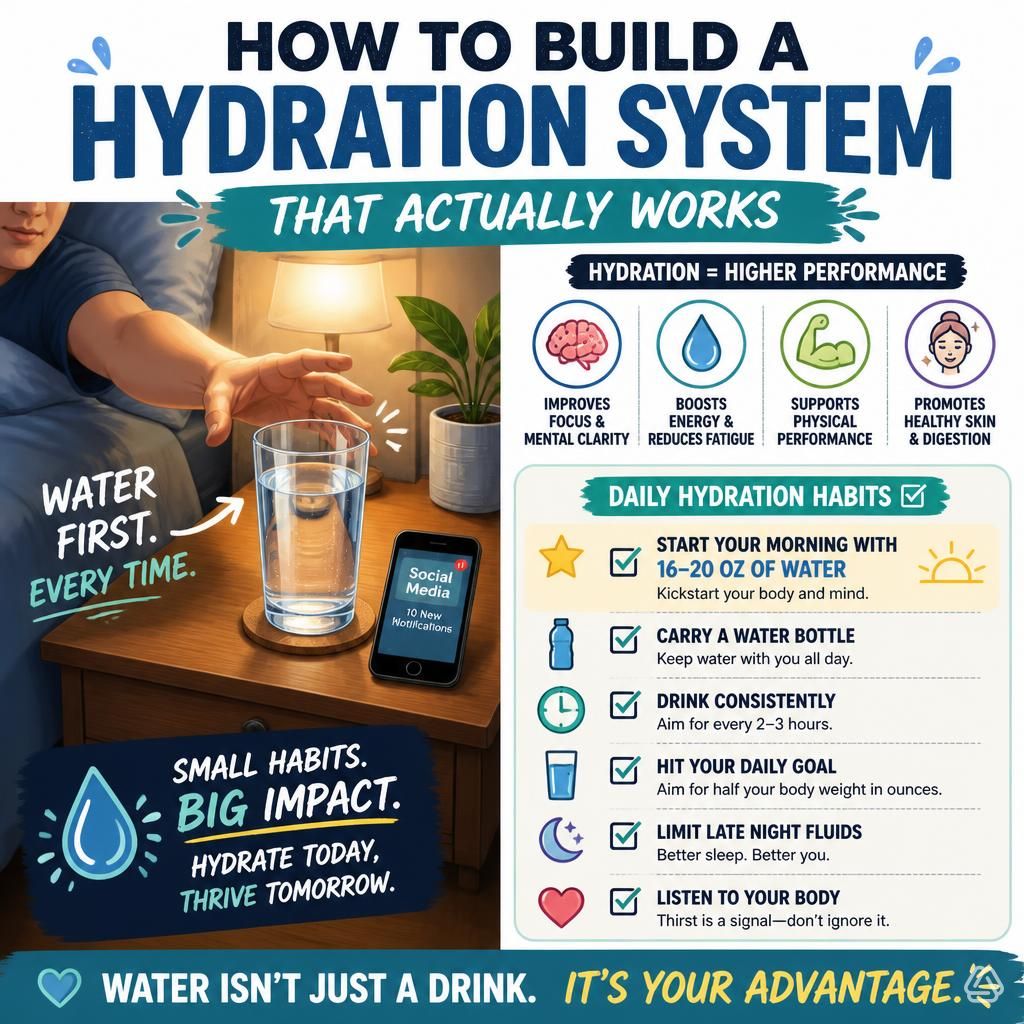
The single most powerful shift you can make is to start every morning with 16–20 oz of water before your first coffee. Your body loses fluid overnight through breathing and light perspiration, so you wake up already slightly dehydrated. Rehydrating first thing primes your brain before caffeine enters the picture. Keep a glass or bottle on your nightstand so it’s the first thing you reach for — before your phone, before anything else.
From there, the key is habit stacking — tying water intake to things you already do automatically. Every time you sit down at your desk, take a few sips. Every time you stand up, drink before you walk away. Before each meal. After every bathroom break. You’re not relying on thirst or willpower; you’re weaving hydration into the rhythm of your existing day, which is the only approach that reliably works long-term.
For a real-time check on your hydration status, use the urine color rule: pale yellow means you’re well hydrated; dark yellow means you’re behind; colorless and completely clear can occasionally signal over-hydration (rare, but possible). It’s the simplest, most honest biofeedback system available — and it costs nothing.
One thing many people overlook: plain water alone may not be enough if you sweat, exercise regularly, or drink multiple cups of coffee per day. Electrolytes — particularly sodium and potassium — are essential to the sodium-potassium pump that drives every nerve signal in your brain. A simple daily upgrade: add a small pinch of Himalayan sea salt and a squeeze of lemon to your morning water, or consider a low- or no-sugar electrolyte supplement. This one habit meaningfully improves how efficiently your brain absorbs and uses the water you’re already drinking.
Finally, try what we call the 30-Before Rule: drink 8–12 oz of water in the 30 minutes before any mentally demanding task — a big meeting, a writing session, a study block, a creative project. This is a simple, zero-cost performance edge that most high performers have never even considered. Your brain will be better primed, more alert, and ready to fire at a higher level. Make it a non-negotiable part of your pre-work ritual.
💧 WellnessWays Quick Tip
Keep a 32 oz water bottle at your desk and commit to finishing it by noon. That single habit, combined with your morning glass, puts most people within striking distance of their daily hydration target before the afternoon even starts.

Hydration and Brain Performance — The Quick Science Summary
The research backing all of this up is both robust and reassuring — because it means the solution is genuinely within your control. A landmark study from the University of East London and the University of Westminster found that drinking water before cognitive tasks improved reaction time by up to 14%. That’s not a marginal gain — that’s the difference between a sharp, responsive mind and one that’s lagging behind its own thoughts.
Additional research consistently shows that adequate hydration improves working memory, sustained attention, and processing speed — the exact cognitive functions that determine how well you think, learn, and perform under pressure. And perhaps most encouragingly, the benefits begin to appear within approximately 20 minutes of drinking adequate water. That makes hydration one of the fastest-acting cognitive interventions available to you — no prescription, no cost, no waiting period.
You already have one of the most effective brain-performance tools ever studied sitting in your kitchen. It’s called water.

Start Tomorrow Morning — Your Brain Will Thank You
Here’s the bottom line: hydration is the most underutilized brain optimization tool in existence. It requires no supplements, no equipment, no special diet, and no significant time investment. What it does require is consistency and a system — and now you have one.
Start tomorrow morning. Before your coffee, before your phone, before anything else — pour 16 oz of water and drink it. Pay attention to how you feel by mid-morning. Notice your focus, your mood, your energy. Give your brain what it’s been quietly asking for, and it will respond faster than you might expect.
Ready to take this further? Hydration is just one piece of the morning routine that can completely transform how your brain performs. Explore the WellnessWays Ultimate Morning Routine for Brain Clarity — Complete Guide to build a full system around your best cognitive day. And if brain fog is something you deal with regularly, don’t miss the WellnessWays Brain Fog resource hub for a deeper dive into causes, patterns, and proven fixes.
Not sure what’s causing your brain fog? Take our free 3-minute Root Cause Quiz and get your personalized action plan! → [Take The Quiz]