
Boost metabolism after 50 Naturally
Introduction
Most metabolism-boosting advice is written for bodies in their 20s and 30s. Green tea extract. Spicy food. Cold showers. While these things have minor metabolic effects, they address none of the significant biological mechanisms driving metabolic slowdown after 50.

Genuine, meaningful metabolic improvement in adults over 50 requires a different approach — one that directly targets the five root causes of age-related metabolic decline: muscle loss, hormonal changes, mitochondrial aging, gut microbiome shift, and appetite hormone dysregulation.
Here are five evidence-based strategies that actually address those root causes — and the research that supports them.
Method 1 — Resistance Training: The Non-Negotiable Foundation
If you could only do one thing for your metabolism after 50, resistance training would be it. Nothing else addresses the primary driver of metabolic slowdown — muscle loss — as directly and effectively.
The science: A 2017 meta-analysis in Obesity Reviews analyzing 39 studies found that resistance training in adults over 50 produced significant increases in resting metabolic rate — averaging approximately 96 extra calories burned per day at rest — along with meaningful reductions in fat mass and improvements in insulin sensitivity.
Why it works for metabolism: Every pound of muscle you build raises your resting metabolic rate. Muscle tissue burns approximately six calories per pound per day at rest — fat burns only two. Adding five pounds of muscle raises your BMR by approximately 30 calories per day — permanently, without any additional effort.
Additionally, resistance training produces a significant post-exercise oxygen consumption (EPOC) effect — the “afterburn” — where metabolism remains elevated for up to 48 hours following a session as muscles repair and rebuild.
How to start: Three sessions per week. Focus on compound movements that engage multiple muscle groups simultaneously: squats, deadlifts, bent-over rows, push-ups or chest presses, and overhead presses. Start with bodyweight or light resistance and progress gradually. You do not need a gym — resistance bands and bodyweight exercises produce meaningful results.
The minimum effective dose: Research suggests that even one set of each major compound movement, performed to near-muscular failure, three times per week is sufficient to produce measurable muscle preservation and metabolic improvement in older adults.
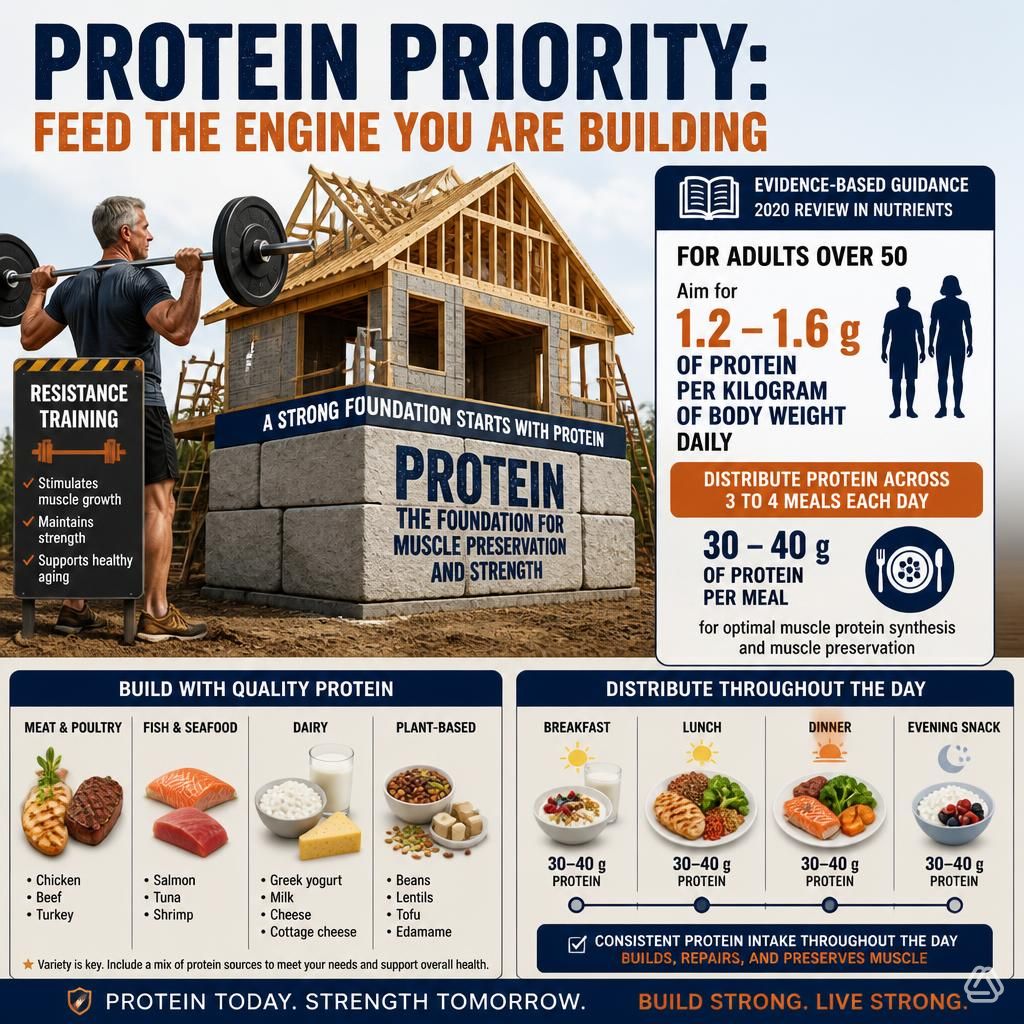
Method 2 — Protein Priority: Feed the Engine You Are Building
Resistance training without adequate protein is like building a house without materials. The training provides the stimulus — protein provides the raw material for muscle synthesis.
The science: A comprehensive 2020 review in Nutrients concluded that adults over 50 require significantly more dietary protein than the current RDA to maintain muscle mass and support metabolic health — recommending 1.2 to 1.6 grams per kilogram of body weight per day, distributed evenly across three to four meals.
The research on protein distribution matters: muscle protein synthesis is maximized by consuming 30 to 40 grams of high-quality protein per meal — not all in one sitting. Spreading protein intake throughout the day produces significantly better muscle preservation outcomes than back-loading protein at dinner.
The metabolic bonus: Protein has a thermic effect of 20 to 30 percent — meaning your body burns 20 to 30 calories digesting every 100 calories of protein you consume. Compared to fat (3 to 5 percent thermic effect) and carbohydrates (5 to 10 percent), protein is the most metabolically favorable macronutrient for adults focused on weight management.
Practical targets: A 160-pound (73 kg) adult needs approximately 88 to 117 grams of protein per day. Best sources: Greek yogurt, eggs, cottage cheese, chicken breast, salmon, sardines, lean beef, lentils, and edamame.
Leucine: Pay particular attention to leucine — the amino acid that most powerfully stimulates muscle protein synthesis. Research shows that a threshold of approximately 2.5 to 3 grams of leucine per meal is required to maximally stimulate the muscle-building response. Whey protein, eggs, and animal proteins are richest in leucine.
Method 3 — Intermittent Fasting: Reset Insulin and Unlock Fat
Intermittent fasting — specifically the 16:8 pattern — has accumulated strong evidence as a metabolic health intervention for adults over 50, with effects that go well beyond simple calorie reduction.
The science: A 2020 Cell Metabolism study found that time-restricted eating (16:8 intermittent fasting) produced significant reductions in visceral fat, blood pressure, and insulin resistance in overweight adults over 45 — with participants reporting no increase in hunger. A 2022 New England Journal of Medicine meta-analysis confirmed that intermittent fasting produces metabolic improvements that are at least equivalent to, and in some metrics superior to, continuous calorie restriction.
Why it works beyond calorie reduction: The fasted state dramatically reduces circulating insulin levels. Lower insulin is the key that unlocks fat cells — allowing stored fat to be released for energy. For adults whose fat cells are partially “locked” due to ceramide-driven insulin resistance, the extended fasted state provides a window in which fat metabolism can actually occur.
Additionally, fasting periods activate AMPK — the cellular energy sensor and “metabolic master switch” — which upregulates fat oxidation and mitochondrial function.
How to implement it: Stop eating by 7 PM. Do not eat again until 11 AM the following day. Coffee and tea (without milk or sugar) are acceptable in the fasted window. Start with a 12-hour fast if 16 hours feels too challenging — and work up over two to three weeks.
Important caveat: Do not skip protein. Your first meal at 11 AM should include at least 30 to 40 grams of protein to protect muscle mass during the fasted period.
Method 4 — Deep Sleep: The Hormone Optimization Window
Sleep is not passive. For metabolic health, deep slow-wave sleep is the most important hormonal event of the day — and it is being systematically undermined by late-night screens, alcohol, stress, and irregular schedules in the exact population that needs it most.
The science: Growth hormone — one of the most powerful fat-metabolizing hormones in the body — is secreted in pulses during slow-wave sleep. Adults who achieve consistent deep sleep have measurably better body composition outcomes than those who do not — even with identical diet and exercise.
A 2010 study in Annals of Internal Medicine placed participants in a calorie-restricted diet with either 8.5 or 5.5 hours of sleep. The well-slept group lost 55 percent more fat mass and significantly more of their total weight loss came from fat rather than muscle. The sleep-deprived group lost the same total weight but lost proportionally more muscle — with worse metabolic consequences.
Additionally: Sleep deprivation elevates ghrelin (hunger hormone) by up to 28 percent and reduces leptin (satiety hormone) by 18 percent — creating the neurobiological conditions for overeating the following day, independent of willpower.
How to improve deep sleep: Eliminate all screens by 9 PM. Set bedroom temperature to 65 to 67°F. Keep a consistent sleep and wake time — even on weekends. Eliminate alcohol within three hours of bedtime. Consider magnesium L-Threonate in the evening — the only form shown to cross the blood-brain barrier and support slow-wave sleep quality.

Method 5 — Gut Microbiome Support: The Metabolic Ecosystem
Your gut microbiome does not just affect digestion. It is a metabolic organ in its own right — regulating how efficiently you extract energy from food, how your body distributes fat, and how sensitive your tissues are to insulin.
The science: A 2019 Nature Medicine study found that supplementing with Akkermansia muciniphila (a keystone gut bacterial species associated with metabolic health) significantly improved insulin sensitivity, reduced visceral fat mass, and improved cardiometabolic markers in overweight adults. A 2021 Cell Host and Microbe study identified that specific gut bacterial species produce short-chain fatty acids that directly regulate fat metabolism in adipose tissue.
Adults over 50 typically show significant reductions in the diversity and abundance of metabolically beneficial gut bacteria — making microbiome restoration a meaningful metabolic intervention.
Prebiotic fiber: Garlic, onions, leeks, asparagus, chicory root, and green bananas feed the metabolically beneficial species. Aim for at least 10 grams of prebiotic fiber daily.
Fermented foods: Daily consumption of Greek yogurt, kefir, kimchi, sauerkraut, or kombucha has been shown to increase microbiome diversity within 4 weeks. A 2021 Stanford study found that fermented food consumption produced significantly greater microbiome diversity than high-fiber diet alone.
Avoid microbiome disruptors: Artificial sweeteners, excessive alcohol, ultra-processed foods, and unnecessary antibiotic use all significantly reduce microbiome diversity. Replace artificially sweetened drinks with water, sparkling water, or herbal tea.
Putting It Together — The Weekly Metabolism Protocol
| Day | Key Action | Metabolic Effect |
| Monday | Resistance training + 35g protein at each meal | Muscle building, BMR increase |
| Tuesday | 16:8 fast + 30 min zone 2 cardio | Insulin reset, mitochondrial support |
| Wednesday | Resistance training + fermented food + 9 PM screen off | Muscle + microbiome + deep sleep |
| Thursday | 16:8 fast + prebiotic fiber focus | Gut microbiome + insulin sensitivity |
| Friday | Resistance training + full protein day | Muscle protein synthesis peak |
| Saturday | 30 min zone 2 cardio + sleep priority | Mitochondrial + hormonal reset |
| Sunday | Rest + meal prep for protein targets | Recovery + habit architecture |
Conclusion
There is no single metabolism-boosting trick that works for adults over 50. But there are five strategies — each targeting a specific root cause of age-related metabolic decline — that, combined, produce genuine, measurable, and sustainable metabolic improvement.
Start with one. Master it for two weeks. Add the next. By week ten you have all five operating together — and the cumulative effect is a metabolic environment fundamentally different from where you started.
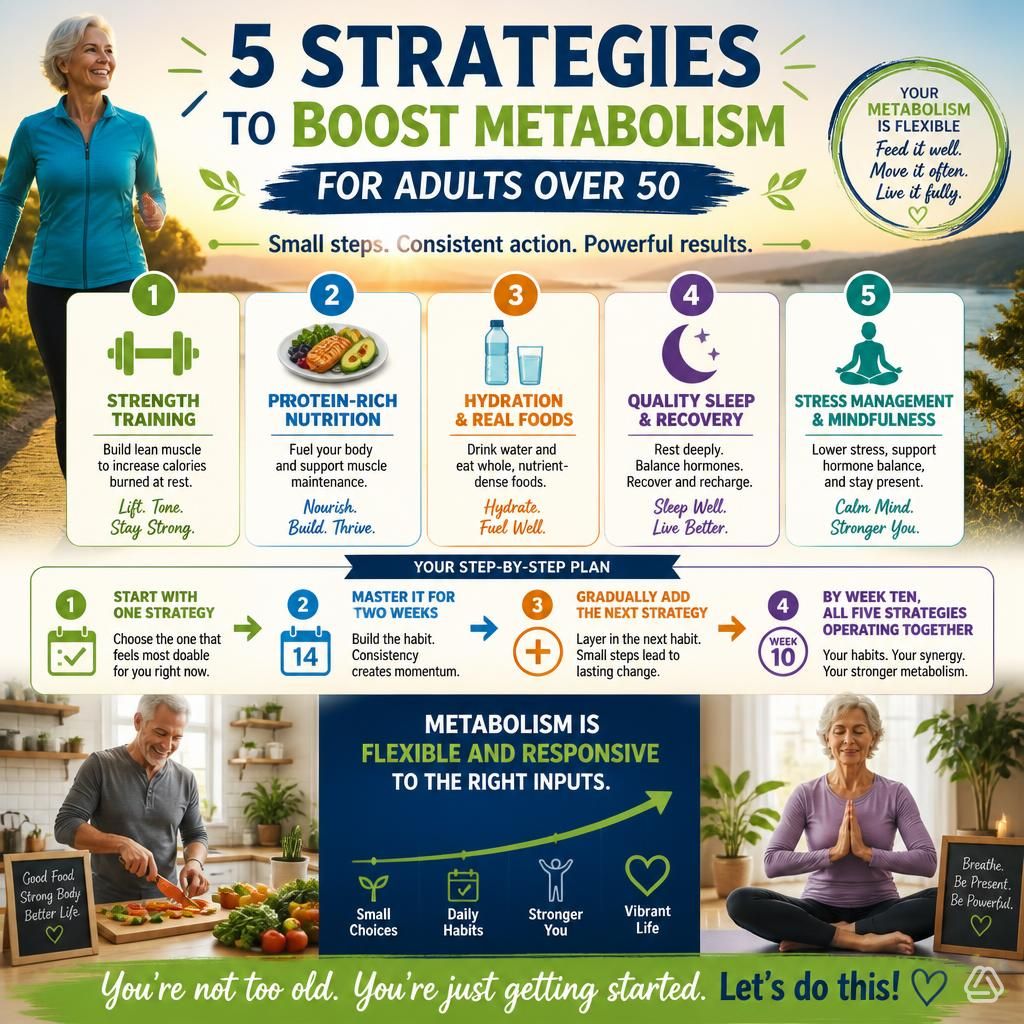
Your metabolism is not fixed. It responds to the right inputs. Give it those inputs.
[Read the complete Metabolism After 50 Pillar Guide →] | [Learn about GLP-1 — the hormone supporting these metabolic pathways →]
Not sure what’s causing your brain fog? Take our free 3-minute Root Cause Quiz and get your personalized action plan! → [Take The Quiz]
Disclaimer: This article is for informational purposes only. Consult a healthcare professional before making significant changes to your diet or exercise routine.