
WellnessWays.net
Evidence-based wellness for real people | Brain & Cognitive Health
Published: October 05, 2026 • Category: Nootropics & Brain Health • Reading time: ~12 min
The Complete Guide to Nootropic Stacking for Beginners: What Works, What Doesn’t, and Where to Start
A credible, practical, hype-free roadmap for anyone curious about combining cognitive supplements intelligently.

Think of your brain as an orchestra. A single violin — even a masterfully played one — produces something beautiful, but limited. Now imagine adding a cello, a woodwind section, a soft percussion backdrop. Suddenly you have something richer, more dimensional, more powerful than any single instrument could achieve alone.
That’s the core logic behind nootropic stacking: combining two or more cognitive-enhancing compounds that act on different brain pathways simultaneously, producing effects that are greater — and often safer — than cranking up a single ingredient to high doses. It’s one of the most discussed strategies in the cognitive health space right now, and for good reason.
But here’s the honest part most guides skip: done wrong, stacking is either a waste of money or a recipe for side effects you can’t diagnose. The supplement industry loves complexity because complexity sells products. This guide cuts through it. You’ll learn what nootropic stacking actually is, which compounds have real science behind them, exactly how to start as a beginner, and — just as importantly — what to avoid.
🌿 The Foundation Rule — Don’t Skip This
Nootropics are amplifiers — they work best when layered on top of a solid lifestyle foundation: consistent quality sleep (7–9 hours), regular aerobic exercise, and whole-food nutrition. Without this foundation, even the best-formulated nootropic stack produces a fraction of its potential effect.
No pill outperforms a good night’s sleep. Build the base first, then stack. See: The WellnessWays Brain Clarity Foundation Protocol ↗
What Is a Nootropic Stack?
A nootropic stack is a combination of two or more cognitive-enhancing compounds taken together — either simultaneously or at complementary times of day — with the goal of producing synergistic effects on brain function that exceed what any single ingredient would produce on its own.
The key word is synergy. When two compounds target different but complementary mechanisms, they can amplify each other’s effectiveness. A classic example: one compound boosts the production of acetylcholine (a neurotransmitter central to memory and learning), while a second compound protects the neurons that depend on that acetylcholine. Together, you get both more signal and better preservation of the hardware transmitting it. Neither ingredient alone accomplishes both tasks.
Nootropic stacks come in two broad forms:
- Pre-formulated stacks — single products sold with multiple ingredients already combined (e.g., “brain formulas,” “cognitive blends”). Convenient, but problematic for beginners (more on this shortly).
- Self-assembled stacks — individual supplements purchased and combined yourself, giving you full control over doses, sources, and the ability to identify what’s actually working.
For beginners, self-assembled stacks are almost always the better starting point. When a 15-ingredient capsule makes you feel different — for better or worse — you have no idea which ingredient caused it.
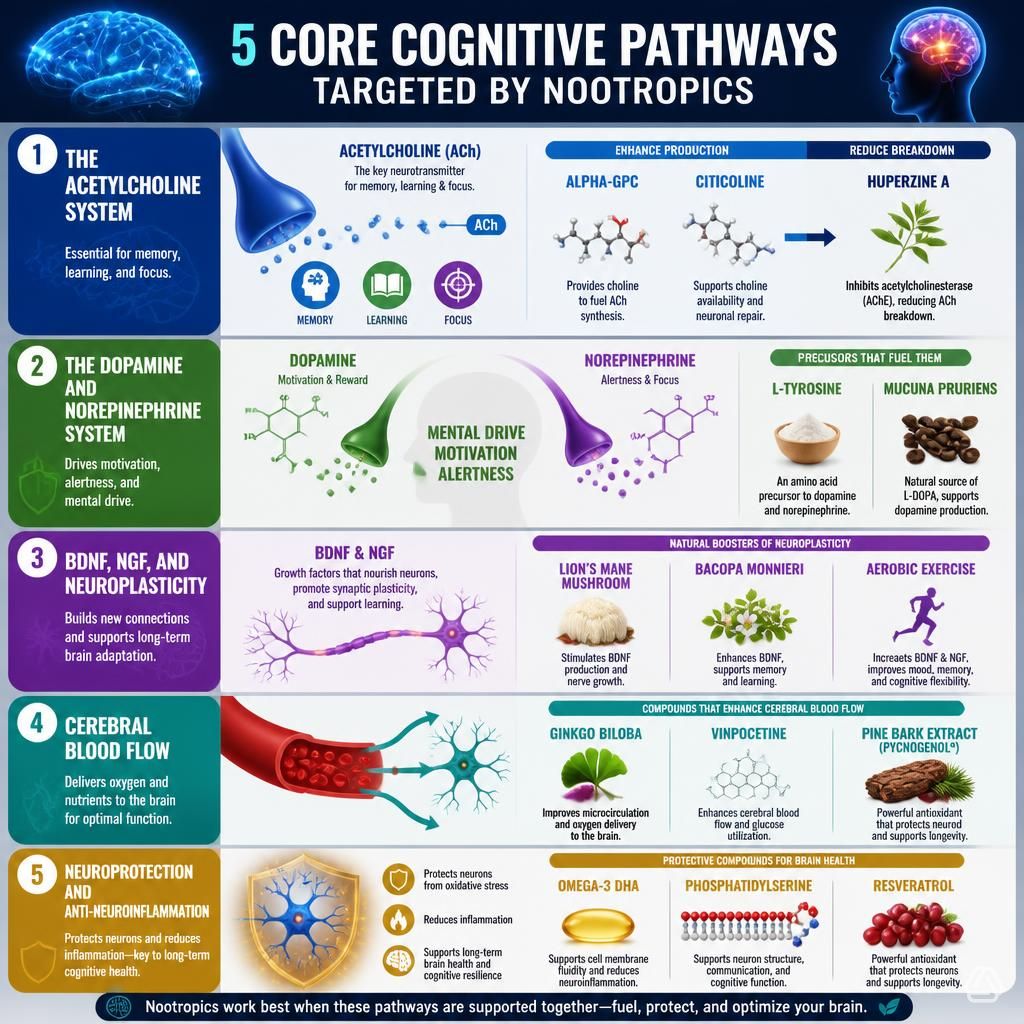
The Core Cognitive Pathways Nootropics Target
Understanding why certain compounds are stacked together requires a basic map of the mechanisms nootropics act on. You don’t need a neuroscience degree — here’s an accessible breakdown of the five main systems:
1. The Acetylcholine System
Acetylcholine is the brain’s primary neurotransmitter for memory formation, learning speed, and focused attention. When acetylcholine signalling is strong, new information sticks faster and mental effort feels smoother. Compounds that support this system include Alpha-GPC, citicoline (CDP-choline), and huperzine A. Choline sources (Alpha-GPC, citicoline) increase acetylcholine production; huperzine A slows its breakdown — a classic stacking synergy.
2. The Dopamine and Norepinephrine System
Dopamine drives motivation, reward, and working memory. Norepinephrine sharpens alertness and executive focus. These are the systems targeted aggressively by prescription stimulants — which is why modulating them with gentler, nutritional precursors rather than direct agonists is the safer, more sustainable approach. Key compounds: L-tyrosine (dopamine and norepinephrine precursor), Mucuna pruriens (natural L-DOPA source).
3. BDNF, NGF, and Neuroplasticity
Brain-Derived Neurotrophic Factor (BDNF) and Nerve Growth Factor (NGF) are proteins that stimulate the growth and maintenance of neurons — essentially “fertiliser” for brain cells. Supporting neuroplasticity means your brain adapts, learns, and repairs more effectively over time. This is where Lion’s Mane mushroom shines (NGF stimulation), alongside Bacopa monnieri and — perhaps most powerfully — aerobic exercise, which is one of the most reliable BDNF stimulators known.
4. Cerebral Blood Flow
Your neurons consume disproportionate amounts of oxygen and glucose. Better circulation means better nutrient and oxygen delivery to brain cells — which translates to sharper processing under cognitive load. Compounds associated with improved cerebral blood flow include Ginkgo biloba, vinpocetine, and pine bark extract (Pycnogenol). Note: ginkgo in particular has drug interaction considerations (see the safety section below).
5. Neuroprotection and Anti-Neuroinflammation
Chronic low-grade neuroinflammation is implicated in cognitive decline and mental fatigue. Protecting existing neurons is often unglamorous compared to “boosting” them — but it’s arguably more important long-term. Key compounds: omega-3 DHA (the structural fat of brain cell membranes), phosphatidylserine, and resveratrol. Omega-3 DHA is foundational enough that it belongs in nearly every beginner stack.
The Beginner’s First Stack — Start Here (Not With Complex Multi-Ingredient Products)
This is the most important section of this guide. Read it before you buy anything.
Before you consider any pre-formulated “brain formula,” start with individual ingredients — one at a time. Here’s why this matters: if you begin with a 15-ingredient product and feel great, you don’t know what’s working. If you feel worse, you can’t identify the culprit. You’re essentially running 15 uncontrolled experiments simultaneously.

The self-assembly approach — introducing one compound at a time, 1–2 weeks apart — is slower, but it gives you real, usable data about your biology. See our companion guide for navigating labels intelligently: How to Read a Supplement Label — A Plain-English Guide ↗
🧠 Beginner Stack A — The Foundation Stack (Gentle, Safe, Well-Studied)
| Compound | Dose | Timing | Primary Role |
|---|---|---|---|
| Omega-3 DHA | 1,000–2,000mg daily | With a meal (fat aids absorption) | Foundational brain fat; neuroprotection, anti-inflammation, synaptic support |
| Citicoline (CDP-Choline) | 250–500mg daily | Morning | Acetylcholine production; brain cell membrane integrity; attention support |
| Lion’s Mane Mushroom | 500–1,000mg daily | Morning or with meals | NGF stimulation; neuroplasticity; gentle, well-tolerated |
| Magnesium Glycinate | 300–400mg | 30–60 min before bed | Sleep quality; stress resilience; NMDA receptor modulation |
Introduction protocol: Add one compound at a time, 1–2 weeks apart, and note any changes in sleep, focus, mood, or digestion before adding the next.
This stack is chosen deliberately for its exceptional safety profile, solid evidence base, and wide availability. None of these compounds are grey-market or poorly understood. Omega-3 DHA is literally the fat your brain cell membranes are made of. Citicoline has been studied in randomised controlled trials showing improvements in attention and memory measures at doses of 250–500mg daily. Lion’s Mane has a plausible, well-characterised NGF-stimulation mechanism — though human trial evidence is still accumulating. Magnesium glycinate addresses one of the most common nutritional gaps in adults and directly supports the quality of sleep that makes every other nootropic work better.
The 8–12 Week Rule
Here’s where most beginners go wrong: they abandon an effective stack too early. Unlike a cup of coffee, the most evidence-backed nootropics don’t announce themselves within an hour. They work through mechanisms that unfold over weeks and months.
- Bacopa monnieri shows peak memory effects at the 8–12 week mark in clinical trials — not day one.
- Lion’s Mane neuroplasticity effects accumulate gradually through consistent NGF stimulation — one 16-week Japanese randomised trial in older adults showed meaningful cognitive improvements that wouldn’t have been visible at week two.
- Citicoline shows the fastest signal of the evidence-backed nootropics, but still produces its most meaningful effects with consistent use over several weeks.
The rule: give any new stack a full 8–12 weeks before drawing conclusions. Track your experience with simple, consistent notes — sleep quality, task focus, word recall, mental energy mid-afternoon. Subjective but consistent self-observation is genuinely useful data. For a deep dive on one of the most patience-rewarding compounds: Bacopa Monnieri — Memory, Dosage, and What the Research Actually Says ↗
Intermediate Stacking — Adding Compounds After 4–8 Weeks
Once you’ve established the Foundation Stack, noted your baseline responses to each compound, and confirmed good tolerance, you can begin adding intermediate-level compounds — still one at a time, with 1–2 weeks between additions.
| Compound | Dose | Notes |
|---|---|---|
| Bacopa Monnieri | 300mg standardised to 55% bacosides, with food | Memory consolidation, anxiety reduction. Requires 8–12 weeks for full benefit. Can cause GI discomfort if taken without food. |
| Alpha-GPC | 300mg, morning | Superior choline source; pairs synergistically with Lion’s Mane. Step up from citicoline, not a replacement — consider alternating or using one consistently. |
| L-Theanine + Caffeine | 100–200mg L-Theanine with morning coffee | The single best-researched beginner cognitive stack available. L-Theanine modulates caffeine’s jitteriness while preserving alertness and focus. Multiple double-blind trials confirm this combination. If you drink coffee already, adding L-Theanine is the easiest meaningful upgrade you can make today. |
💡 Why L-Theanine + Caffeine Is Special
The L-Theanine and caffeine combination is remarkable because it has robust replicated evidence in healthy adults — not just older populations or people with cognitive impairment. L-Theanine (found naturally in green tea) promotes relaxed alertness via alpha brainwave activity, while caffeine provides stimulant-driven focus. Together they produce a smoother, more sustained cognitive uplift than caffeine alone. If you’re looking for a “what actually works quickly” answer, this is it.
For a comprehensive look at the evidence behind one of the intermediate stack’s most promising compounds, see: Lion’s Mane Mushroom — Complete Evidence Review ↗
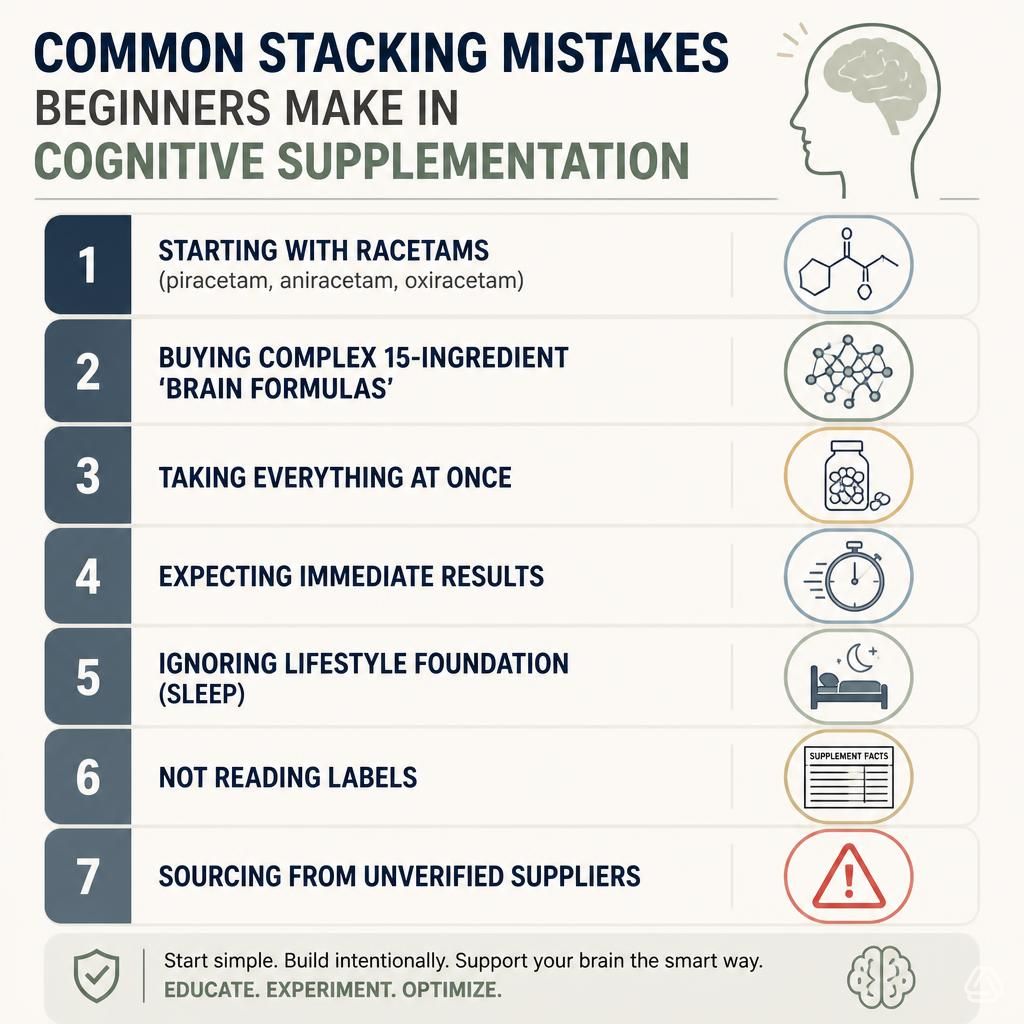
What NOT to Do as a Beginner — Common Stacking Mistakes
The following mistakes are extremely common — and every one of them can undermine an otherwise intelligent approach to cognitive supplementation. Be honest with yourself about which ones you might be tempted by.
- ❌ Starting with racetams (piracetam, aniracetam, oxiracetam). These are among the oldest synthetic nootropics and have vocal communities of supporters. They also have poorly characterised mechanisms in humans, inconsistent choline requirements (too little choline with a racetam can worsen cognition), and limited robust clinical data in healthy adults. They are not beginner territory. Build a foundation first, learn your biology, then revisit if still interested.
- ❌ Buying complex 15-ingredient “brain formulas” first. Marketing complexity is not the same as scientific complexity. Most multi-ingredient proprietary blends underdose individual ingredients relative to therapeutic thresholds used in research — and you cannot identify which ingredient is responsible for any effect, positive or negative.
- ❌ Taking everything at once on day one. Introduce compounds one at a time, 1–2 weeks apart. This is not optional if you want reliable self-knowledge about your responses.
- ❌ Expecting immediate results from long-term nootropics. If a supplement produces a dramatic effect within 20 minutes, it is almost certainly acting as a stimulant — not a true nootropic. That’s not necessarily bad, but it’s different. The real, durable cognitive benefits of evidence-based compounds like Bacopa and Lion’s Mane take weeks to emerge. Chasing “I feel it NOW” typically leads people toward stimulant dependency.
- ❌ Ignoring the lifestyle foundation. Poor sleep eliminates the benefit of almost every nootropic on this list. No stack compensates for chronically sleeping 5 hours. This is not a wellness platitude — it is a biochemical fact about memory consolidation, synaptic pruning, and neuroinflammation clearance (the glymphatic system operates during sleep).
- ❌ Not reading labels or understanding doses. “Proprietary blend” on a label means you don’t know how much of any ingredient you’re actually getting. Know the dose. Know the source. Know whether it’s a standardised extract. See: How to Read a Supplement Label — A Plain-English Guide ↗
- ❌ Sourcing from unverified suppliers. The supplement industry has significant quality control variability. Products that lack third-party testing can be mislabelled, contaminated, or dramatically under-dosed. This matters for both safety and effectiveness.
Quality, Sourcing, and Safety
The honest reality of the supplement industry: product quality varies enormously, and no government agency pre-approves supplements for safety or efficacy before they reach shelves. This places the burden on you as a consumer to be discerning. Here’s what to look for:
Third-Party Testing — Non-Negotiable
Look for products certified by one of the following independent testing bodies, which verify that what’s on the label is actually in the bottle — at the stated dose, without contaminants:
- NSF Certified for Sport — rigorous and widely respected
- Informed Sport / Informed Choice — strong global standard
- USP Verified — US Pharmacopeia quality standard
- Labdoor Tested — independent lab testing with published results
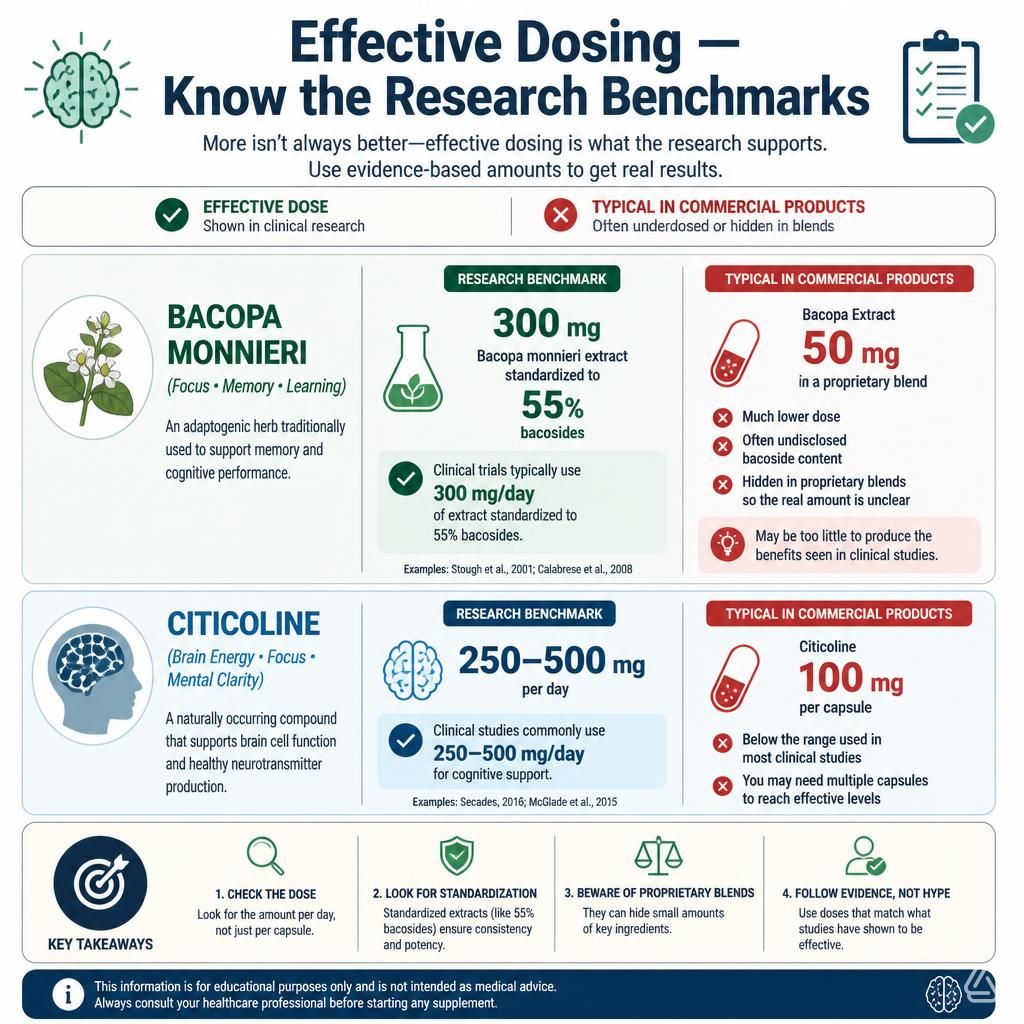
Effective Dosing — Know the Research Benchmarks
Many commercial “brain supplements” are dosed well below the thresholds used in clinical trials. Bacopa monnieri trials typically use 300mg of extract standardised to 55% bacosides. Citicoline trials use 250–500mg daily. A product listing “Bacopa Extract 50mg” in a proprietary blend is not the same thing — and likely won’t produce comparable effects. How to Read a Supplement Study (Without a PhD) ↗
Drug Interactions — Consult a Professional
⚠️ Important: Medication Interactions
Several nootropic compounds have meaningful interactions with common prescription medications. Ginkgo biloba can increase bleeding risk and interact with blood thinners (warfarin, aspirin). St. John’s Wort (sometimes included in “mood nootropic” blends) interacts with antidepressants, contraceptives, and many other drugs. High-dose tyrosine warrants caution with MAOIs and thyroid medications. If you take any prescription medication — particularly blood thinners, antidepressants, blood pressure medications, or thyroid medications — consult your healthcare provider before beginning any new supplement stack.
Cycling Protocols
Some nootropics benefit from periodic cycling to prevent tolerance or receptor downregulation:
- Bacopa monnieri: many practitioners recommend 8 weeks on, 2 weeks off
- Huperzine A: typically 5 days on, 2 days off — it inhibits acetylcholinesterase and daily use can lead to excess acetylcholine
- Racetams (if you progress to these): cycling is commonly recommended and cycle protocols vary by compound
- Foundation Stack compounds (omega-3, citicoline, Lion’s Mane, magnesium glycinate): generally safe and appropriate for consistent daily use
Start Low, Go Slow
Always begin at the lower end of the recommended dose range — typically the lowest dose used in positive research trials. Assess your response for 1–2 weeks before increasing. This protects you from unnecessary side effects and also establishes a personal baseline. Some people are notably more sensitive to cholinergic compounds, for example — knowing this early saves you from unpleasant headaches at higher doses.
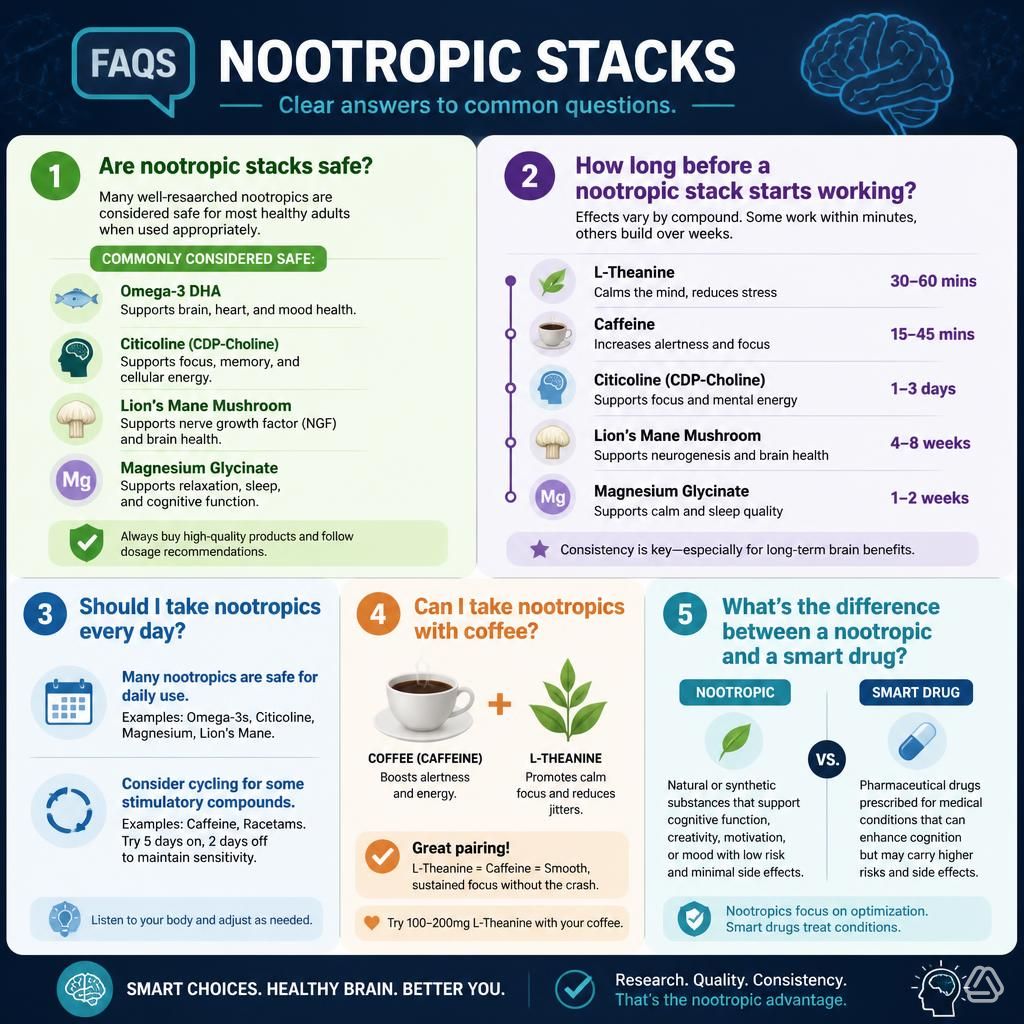
Frequently Asked Questions
This section is marked for FAQPage schema implementation in WordPress.
Q: Are nootropic stacks safe?
The compounds in the recommended Beginner Foundation Stack — omega-3 DHA, citicoline, Lion’s Mane mushroom, and magnesium glycinate — have strong safety profiles and are well-tolerated in the published research literature. More complex stacks involving prescription compounds, grey-market synthetics, or combinations of stimulant-adjacent ingredients carry meaningfully greater risk. As a general rule: the closer a compound is to a drug mechanism (receptor agonism, enzyme inhibition at significant levels), the more carefully it warrants research and professional consultation. Always research each compound individually, start at low doses, and consult a healthcare professional if you have existing health conditions or take any prescription medications.
Q: How long before a nootropic stack starts working?
It depends entirely on which compounds are in the stack. L-Theanine combined with caffeine: noticeable effects within 30–60 minutes. Magnesium glycinate for sleep quality: 1–2 weeks of consistent use. Lion’s Mane for neuroplasticity: meaningful effects emerge over 4–8 weeks. Bacopa monnieri for memory consolidation: research consistently points to 8–12 weeks for peak benefit. This variability is why setting realistic expectations before you start is critical — abandoning an effective long-term compound after three weeks is one of the most common mistakes in nootropic use. Allow a full 8–12 weeks before drawing conclusions about compounds that work through neuroplasticity or neurotransmitter synthesis mechanisms.
Q: Should I take nootropics every day?
For the Beginner Foundation Stack compounds, daily use is generally appropriate and aligns with the dosing protocols used in research studies — these compounds work through mechanisms that benefit from consistent, cumulative exposure. However, some compounds are better cycled. Huperzine A is typically used 5 days on, 2 days off, to prevent acetylcholinesterase inhibition from becoming excessive. Bacopa is often cycled (8 weeks on, 2 weeks off) in practitioner settings. Research the specific cycling recommendations for each compound you use, rather than assuming a blanket daily protocol applies universally.
Q: Can I take nootropics with coffee?
Not only can you — for L-Theanine, you should. The L-Theanine and caffeine combination is specifically designed to be taken together, and this pairing has more robust evidence behind it than almost any other nootropic stack. L-Theanine (100–200mg) taken with your morning coffee smooths out the jitteriness and anxiety that caffeine can cause while preserving and extending the alertness and focus benefits. For most other nootropics in the beginner stack (omega-3, citicoline, Lion’s Mane), taking them with coffee or around your morning coffee is fine. One caution: avoid stacking stimulant-adjacent compounds — like high-dose L-tyrosine — with large amounts of caffeine, as the combined stimulatory load can produce anxiety, elevated heart rate, or restlessness.
Q: What’s the difference between a nootropic and a smart drug?
The term “nootropic” was coined by Romanian psychologist and chemist Dr. Corneliu Giurgea in 1972. His original definition required that a true nootropic must enhance learning and memory, protect brain function, be non-toxic, and have very few side effects — essentially, it should be a cognitive enhancer that also supports long-term brain health. By this definition, most prescription stimulants (Adderall, Ritalin) are not true nootropics — they produce strong acute cognitive effects through dopamine and norepinephrine flooding, but carry significant side effect profiles, dependency risk, and are not neuroprotective. “Smart drugs” is a more colloquial term often applied to prescription stimulants or modafinil used off-label for cognitive enhancement. These are categorically different from the OTC supplement-based nootropics discussed in this guide, with different legal status, risk profiles, and mechanisms. This guide covers only over-the-counter supplement-category nootropics.
✅ Beginner Stack Quick-Start Summary
Everything you need to begin intelligently, in one place:
| Step | Action | Why |
|---|---|---|
| 1 | Establish lifestyle foundation first (sleep, exercise, nutrition) | Nootropics amplify — they don’t replace |
| 2 | Start with Omega-3 DHA (1–2g daily with food) | Foundational brain fat; neuroprotective; well-tolerated |
| 3 | Add Citicoline 250–500mg (after 1–2 weeks) | Acetylcholine support; brain cell membrane integrity |
| 4 | Add Lion’s Mane 500–1,000mg (after another 1–2 weeks) | NGF stimulation; neuroplasticity; gentle |
| 5 | Add Magnesium Glycinate 300–400mg before bed | Sleep quality; NMDA modulation; stress resilience |
| 6 | Add L-Theanine 100–200mg with morning coffee | Best-researched acute cognitive stack; removes caffeine jitter |
| 7 | Commit to 8–12 weeks before evaluating | Long-term mechanisms need time to develop |
| 8 | Choose third-party tested products (NSF, USP, Labdoor) | Quality control in supplements varies enormously |
| 9 | Consult a healthcare provider if on any medications | Some interactions are clinically significant |
| 10 | Add intermediate compounds (Bacopa, Alpha-GPC) only after 4–8 weeks | Build knowledge of your own responses first |
Nootropic stacking is not about becoming a different person. It’s not a shortcut, a replacement for the fundamentals, or a magic formula for productivity. It’s about giving your already capable brain the best possible biochemical environment to perform at its peak — and protecting it for the long term.
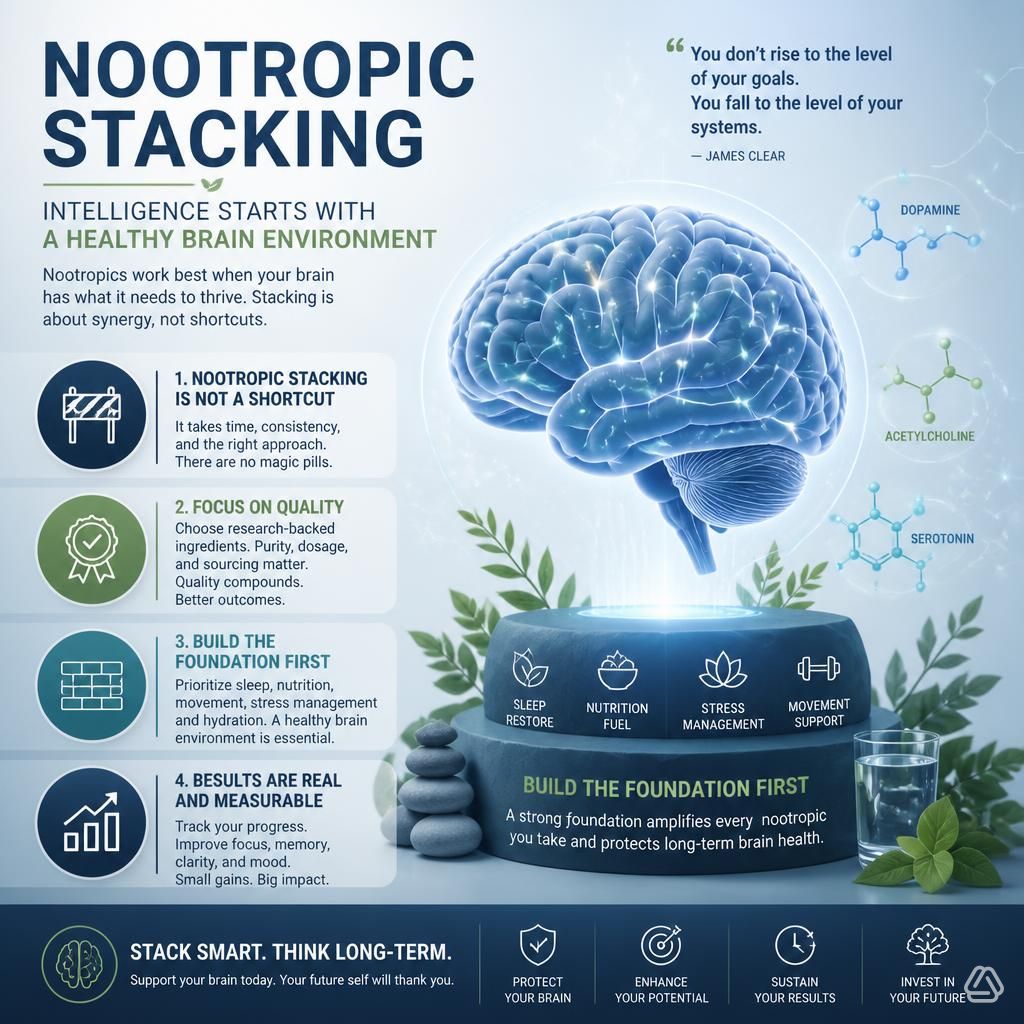
Start simple. Be patient. Prioritize quality. Build the foundation first. The results, when approached with this level of intelligence and honesty, are real and measurable. Your brain is worth the care.
More from WellnessWays Brain & Cognitive Health
- The WellnessWays Brain Clarity Foundation Protocol
- How to Read a Supplement Label — A Plain-English Guide
- Bacopa Monnieri — Memory, Dosage, and What the Research Actually Says
- Lion’s Mane Mushroom — Complete Evidence Review
- How to Read a Supplement Study (Without a PhD)
Disclaimer: The information in this article is for educational purposes only and does not constitute medical advice. Always consult a qualified healthcare professional before starting any new supplement regimen, particularly if you are pregnant, nursing, have a diagnosed health condition, or take prescription medications. WellnessWays does not receive affiliate compensation for specific product recommendations in this article.