
WellnessWays.net
Evidence-based guidance for brain, body & longevity
🧠 Brain & Cognition | Published: September 21, 2026 | 9-minute read | ~2,100 words
Exercise And Brain Health : The Cognitive Case for Moving Your Body
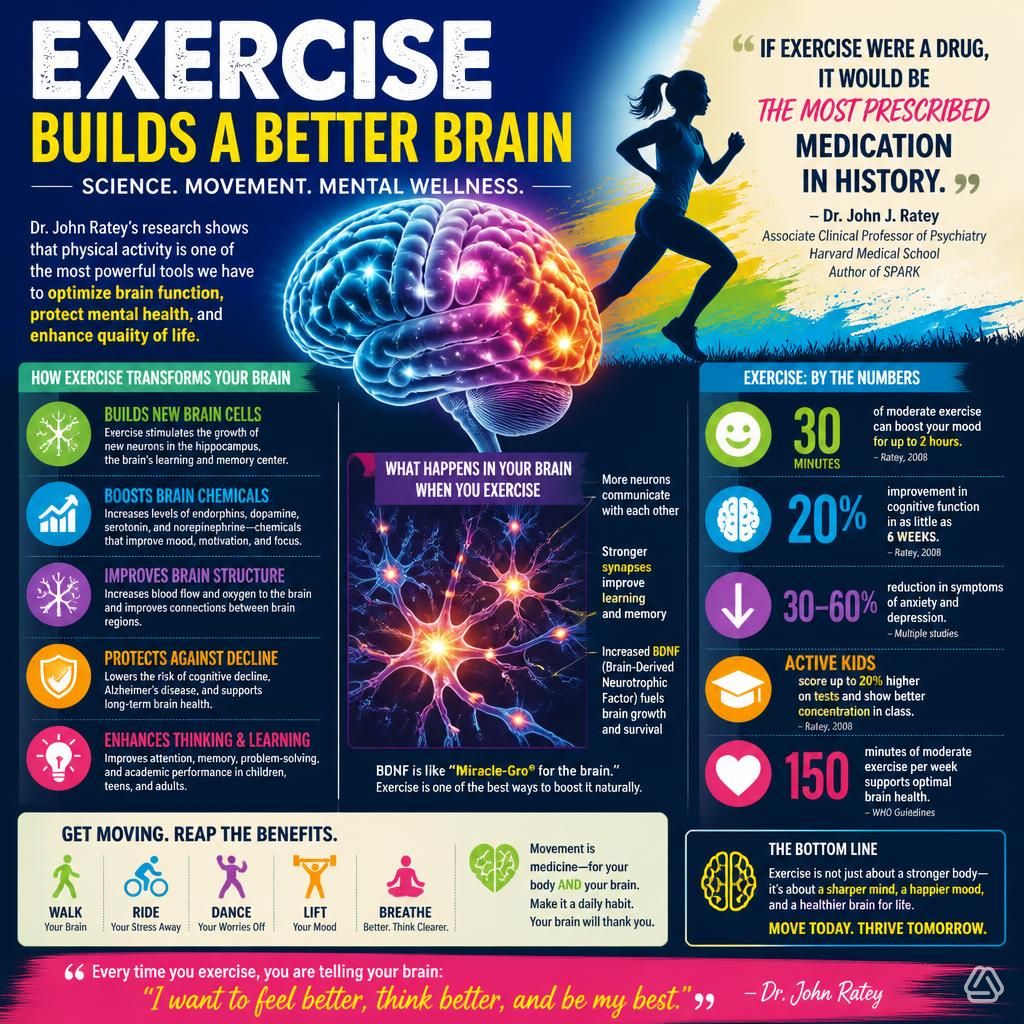
If exercise were a drug, it would be the most prescribed medication in history — and any pharmaceutical company that could bottle its effects would be worth trillions.
That’s not a motivational poster. That’s the considered judgment of Dr. John Ratey, Associate Clinical Professor of Psychiatry at Harvard Medical School, and one of the world’s leading researchers on the brain-exercise connection. He didn’t write that as a rallying cry for fitness influencers. He wrote it after decades of studying what movement actually does inside the human brain — at the cellular, structural, and neurochemical level.
The conclusion he and hundreds of other neuroscientists have reached is striking: the cognitive benefits of exercise are not supplementary to brain health. They are brain health. The brain does not exist in a sealed box above your shoulders, insulated from what your body does. Every walk, every bike ride, every moderately breathless effort sends a cascade of chemical signals upward that literally remodel your neural architecture.
This post is the cognitive case for movement — built on the research, stripped of the guilt, and calibrated specifically for people who aren’t athletes. Because the science is unambiguous: you don’t have to be fit to benefit. You just have to move.
★ The One-Line Summary
Regular aerobic exercise is the most evidence-backed, accessible, and powerful tool for improving cognitive function, protecting against neurodegeneration, and building a resilient, high-performing brain — at any age, at any fitness level.
BDNF — The Star of the Show
Every time you lace up your shoes and move your body at a pace that gets your heart rate up, your brain does something remarkable: it floods itself with a protein called Brain-Derived Neurotrophic Factor — BDNF. If you remember only one acronym from this entire article, make it that one.

BDNF is, in the most literal sense, fertilizer for your brain. Dr. Ratey famously called it “Miracle-Gro for the brain,” and the label is earned. BDNF promotes the growth and survival of neurons, strengthens the connections between them (synaptic plasticity), and supercharges your brain’s capacity to encode new information. It is the central biochemical mechanism connecting exercise to virtually every cognitive benefit we’re about to discuss.
Here’s what makes this especially exciting: aerobic exercise triggers BDNF release in the hippocampus within minutes of starting. You don’t need to complete a marathon. You need to get moving at a moderate intensity and sustain it. The signal begins almost immediately.
Sustained over weeks and months, BDNF elevation produces something even more remarkable: measurable structural changes in the brain itself. The most important target is the hippocampus — the brain region primarily responsible for memory formation and one of the first areas damaged by Alzheimer’s disease.
📊 Landmark Research: A 2011 study by Erickson et al., published in the Proceedings of the National Academy of Sciences (PNAS), followed 120 older adults over one year. Half performed aerobic exercise; half did stretching only. The result: the aerobic exercise group increased hippocampal volume by approximately 2% — effectively reversing 1–2 years of age-related brain shrinkage. Spatial memory improved significantly alongside the structural changes. This wasn’t a subjective wellness survey. It was measured brain growth in adults who had already begun to decline.
In sedentary adults, the hippocampus naturally shrinks at 1–2% per year. Aerobic exercise doesn’t just slow that decline — in the Erickson study, it reversed it. That is an extraordinary finding. It means the brain’s most important memory structure is, to a meaningful degree, a use-it-or-lose-it organ — and exercise is how you use it.
Neurogenesis — Your Brain Can Grow New Neurons
For most of the 20th century, neuroscientists agreed on something that turned out to be completely wrong: that adult brains cannot grow new neurons. You were born with all the neurons you’d ever have, the thinking went, and life was simply a process of losing them.
That consensus was overturned. In 1998, Swedish neuroscientist Peter Eriksson published the first direct evidence of neurogenesis — new neuron growth — in the adult human hippocampus. Subsequent research confirmed what Eriksson’s finding implied: exercise is one of the most powerful known stimulators of this process.
New neurons generated through exercise integrate into the hippocampus’s memory circuits, improving what researchers call pattern separation — your brain’s ability to distinguish similar experiences, memories, and situations from one another. This is the cognitive skill that keeps you from confusing where you parked today versus yesterday, or which version of a conversation you had. When pattern separation degrades, cognitive fog sets in.
🕐 Neurogenesis Timeline
2–4 weeks of consistent aerobic exercise produces measurable new neuron growth in the dentate gyrus of the hippocampus. This isn’t a years-long commitment before you see results — it’s a month. The brain responds quickly when you give it reason to.
The practical implication: brain fog, sluggish recall, and difficulty thinking flexibly are not inevitable. For many adults, they are symptoms of an under-exercised brain — and they are responsive to intervention at any age.
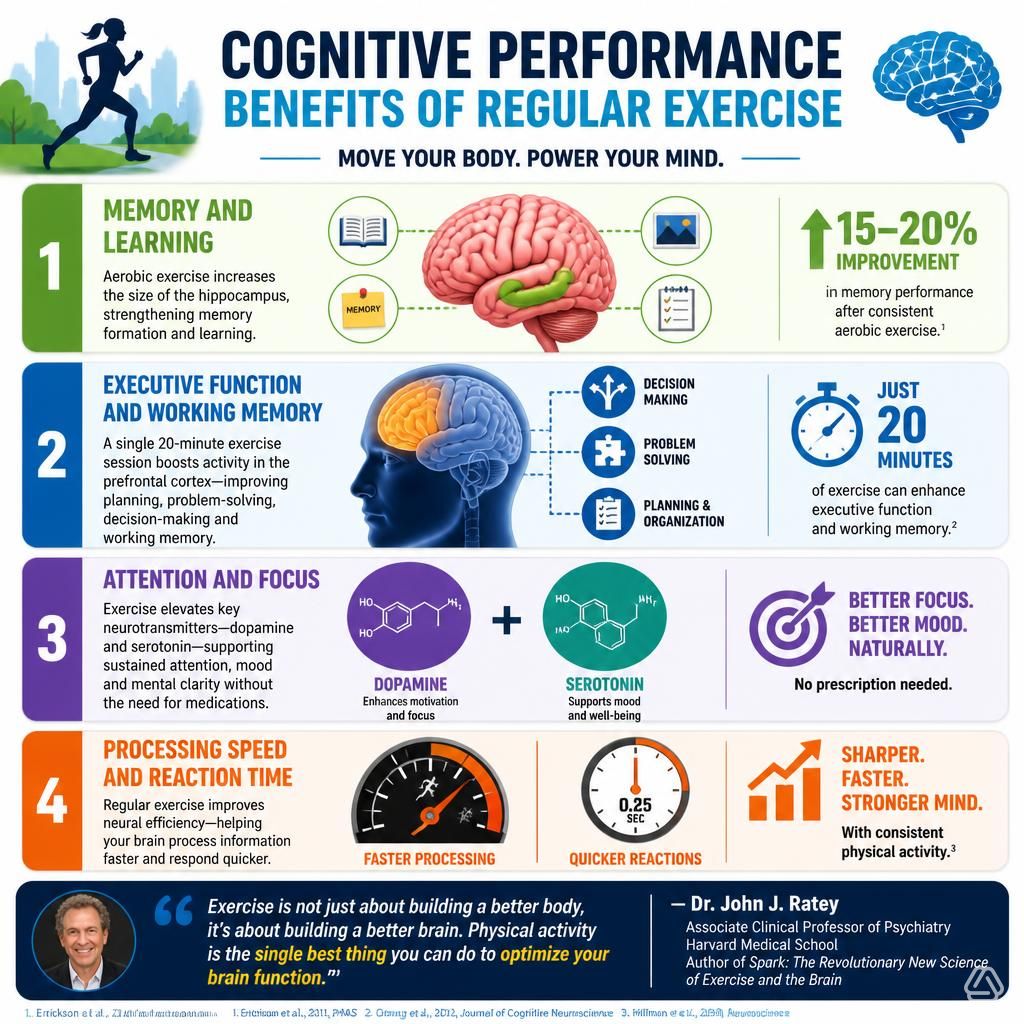
The Cognitive Performance Benefits — What the Research Shows
BDNF and neurogenesis are the mechanisms. Let’s talk about the outcomes — the specific cognitive skills that improve when you exercise regularly, backed by the research that demonstrates each one.
🧠 Memory and Learning
Multiple studies have shown that aerobic exercise performed before or after a learning session improves memory consolidation by 15–20%. The mechanism is elegant: elevated BDNF and norepinephrine post-exercise enhance the brain’s ability to encode and cement new information into long-term memory.
Practical application: A 20-minute brisk walk before studying, an important meeting, or creative work produces measurable improvements in how well you absorb and retain what follows. You are neurochemically priming your brain before you ask it to perform.
🧠 Executive Function and Working Memory
The prefrontal cortex — the seat of decision-making, impulse control, planning, and cognitive flexibility — is exquisitely sensitive to exercise. Research from the Hillman Lab at the University of Illinois has consistently demonstrated that even a single 20-minute bout of moderate-intensity exercise produces significant improvements in executive function, working memory capacity, and inhibitory control — in both children and adults.
Working memory is the cognitive workspace where you hold and manipulate information in real time. It’s what you’re using when you balance a budget, follow a complex argument, or compose an email. Exercise grows that workspace. Inactivity shrinks it.
🧠 Attention and Focus
Exercise increases three neurotransmitters simultaneously: dopamine, norepinephrine, and serotonin. These are the same neurochemical systems targeted by prescription attention medications like Adderall and Ritalin — without the side effects, without the prescription, and without the crash.
“Exercise is the single most powerful tool you have to optimize your brain function.”— Dr. John J. Ratey, Spark: The Revolutionary New Science of Exercise and the Brain
The focus-enhancing effect of a single aerobic session lasts 1–3 hours post-exercise. Time your movement strategically and you’re essentially scheduling a focus window into your day — no caffeine, no supplements required.
🧠 Processing Speed and Reaction Time
Multiple meta-analyses — studies that aggregate findings across dozens of individual studies — confirm that regular exercisers outperform sedentary counterparts on processing speed and reaction time across all age groups. This isn’t about athletic advantage. Processing speed determines how quickly you comprehend information, respond in conversations, and navigate complex decisions. It’s one of the first cognitive skills to decline with age — and one of the most responsive to aerobic training.
Exercise Types and Their Specific Brain Benefits
Not all movement produces identical brain effects. Understanding the distinctions lets you design a protocol matched to your actual goals — even if those goals are modest.
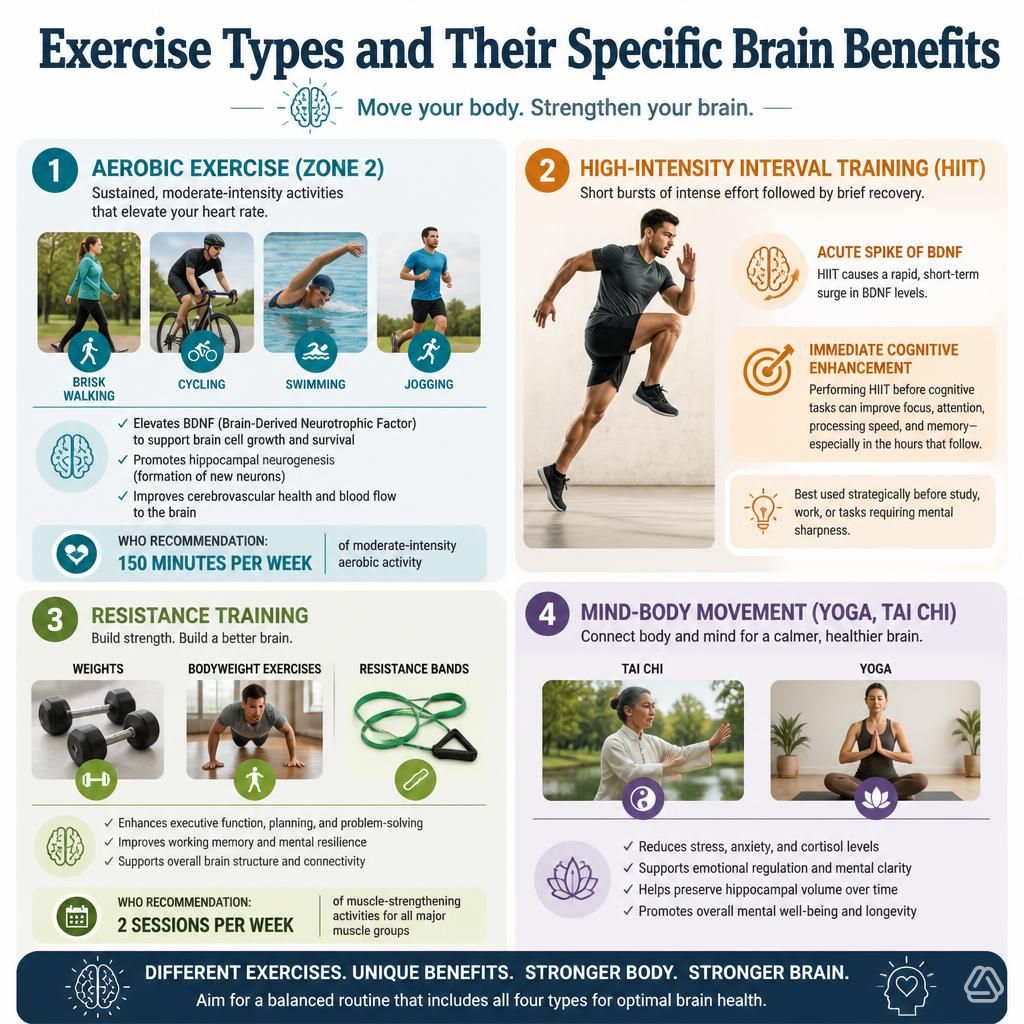
🏃 Aerobic Exercise (Zone 2 — The BDNF Sweet Spot)
Zone 2 cardio — working at 60–70% of your maximum heart rate, a pace at which you can hold a conversation but feel comfortably breathless — is the most evidence-supported form of exercise for long-term cognitive health. Brisk walking, cycling, swimming, and jogging all qualify.
Zone 2 produces sustained BDNF elevation, hippocampal neurogenesis, and improved cerebrovascular health — the health of the blood vessels that feed your brain. The target established by the World Health Organization: 150 minutes per week, achievable in 30-minute sessions five days per week. Or 25 minutes six days. Or any combination that gets you there.
⚡ High-Intensity Interval Training (HIIT)
HIIT produces a sharper, higher acute spike of BDNF than Zone 2 — but for a shorter duration. This makes it excellent for immediate pre-task cognitive enhancement: a 15–20 minute HIIT session before demanding work can produce a pronounced short-term cognitive boost. Cardiovascular benefits are comparable to Zone 2 in significantly less time.
For a cognitively-optimized weekly protocol: 3 Zone 2 sessions + 1–2 HIIT sessions per week gives you both sustained neuroplasticity and acute performance peaks.
🏋 Resistance Training
The evidence for resistance training — weights, bodyweight exercises, resistance bands — in cognitive health has strengthened considerably in recent years. The mechanisms differ from aerobic exercise: resistance training works partly through IGF-1 (insulin-like growth factor-1) production, prefrontal cortex strengthening, and cortisol reduction.
It is particularly powerful for executive function and working memory specifically. The recommendation: 2 resistance sessions per week in addition to aerobic work, for a comprehensive cognitive training effect.
🤵 Mind-Body Movement (Yoga, Tai Chi)
Multiple studies have demonstrated that Tai Chi practice in older adults produces hippocampal volume preservation comparable to aerobic exercise — a remarkable finding for a form of movement most people wouldn’t associate with brain training. The mechanism is primarily stress reduction: Tai Chi and yoga powerfully lower cortisol, and chronic cortisol elevation is one of the most damaging things that can happen to hippocampal tissue. Protecting the brain from stress is as important as building it up.
| Exercise Type | Primary Brain Benefit | Minimum Dose | Best Timing |
|---|---|---|---|
| Zone 2 Aerobic (walk, cycle, swim) | BDNF, neurogenesis, hippocampal growth, long-term neuroprotection | 150 min/week | Morning or pre-learning |
| HIIT | Acute BDNF spike, rapid focus boost, cardiovascular efficiency | 15–20 min, 1–2x/week | Before demanding tasks |
| Resistance Training | Executive function, working memory, IGF-1, cortisol reduction | 2x/week, 20–40 min | Flexible |
| Yoga / Tai Chi | Cortisol reduction, hippocampal protection, stress resilience | 2–3x/week, 20–30 min | Morning or evening |
How Much Exercise Do You Actually Need? (The Minimum Effective Dose)
This is the section for every person who has ever thought, “I don’t have an hour. I can’t even commit to thirty minutes. So what’s the point?”
The research has a surprisingly encouraging answer.
- 10 minutes of moderate aerobic exercise produces measurable acute improvements in processing speed and attention that last over an hour.
- 20 minutes of brisk walking, three times per week, produces measurable long-term cognitive improvements in older adults, per research published in the British Journal of Sports Medicine.
- Even light physical activity — standing up, slow walking, taking stairs — is cognitively superior to unbroken sitting. Movement is not binary. It exists on a spectrum, and every point on that spectrum beats motionlessness.
⚡ Minimum Effective Dose Summary
For immediate cognitive benefit: 10 minutes of moderate aerobic activity (brisk walking, cycling, light jogging). Effects begin within minutes and last 1–3 hours.
For sustained cognitive improvement: 20-minute brisk walks, 3x per week. Measurable memory and executive function gains within 3–4 weeks.
For structural brain change: 150 minutes/week Zone 2 aerobic + 2x resistance training. Hippocampal volume increases measurable at 3–6 months.
The non-negotiable rule: A 10-minute walk is not a failed workout. It is a meaningful neurochemical intervention that produces real brain benefits. Something is infinitely better than nothing.
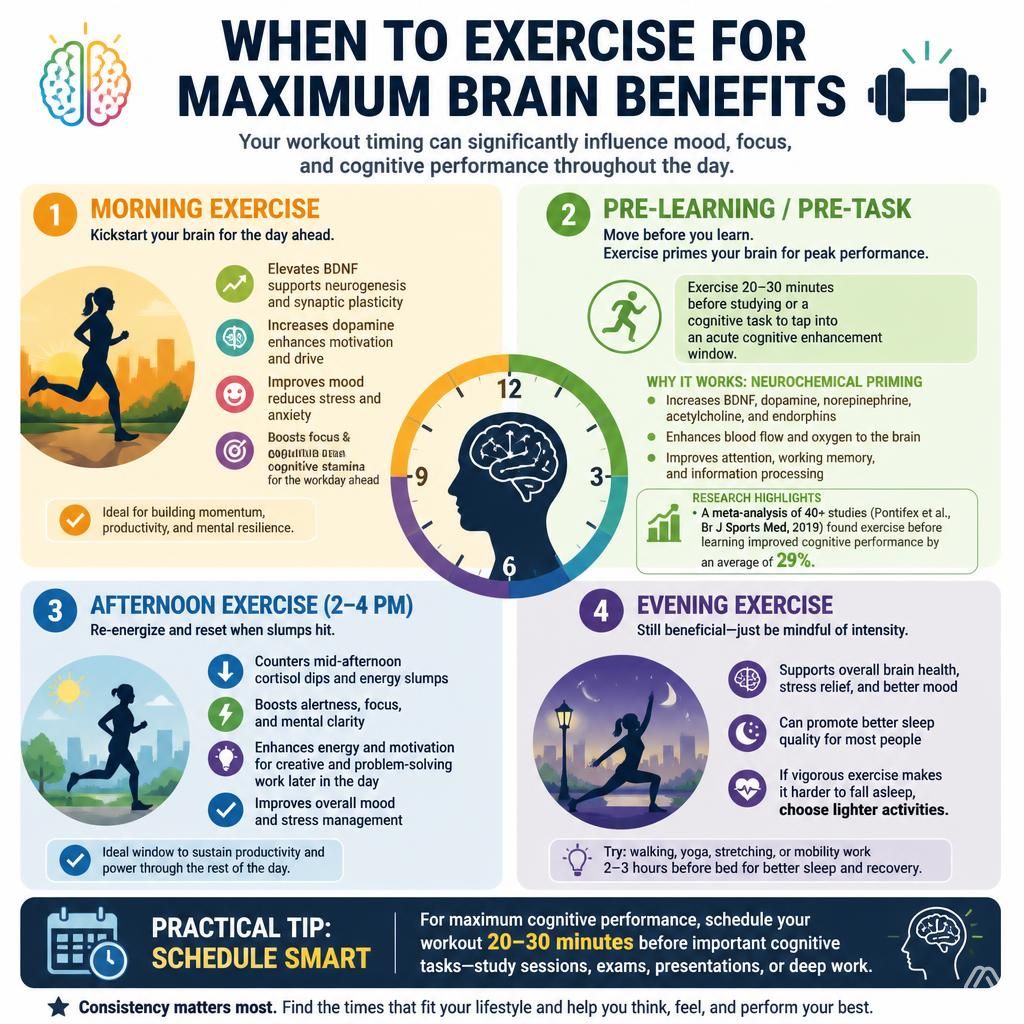
The Timing Question — When to Exercise for Maximum Brain Benefit
When you exercise matters — not as much as whether you exercise, but enough to be worth planning around.
- Morning exercise: Establishes elevated BDNF and dopamine for the entire workday. Improves mood, focus, and cognitive stamina from the moment you sit down to work. Best strategy for sustained daily cognitive performance and consistency.
- Pre-learning / pre-task (20–30 min before study or important work): The most potent acute cognitive enhancement window. Your brain is neurochemically primed for encoding and performance in the 1–3 hours that follow. This is the timing used in most laboratory learning-and-exercise studies — and the results are consistently significant.
- Afternoon (2–4 pm): Directly combats the cortisol dip and energy slump that most adults experience mid-afternoon. Produces a focus and energy boost that carries into the early evening — useful if you do your best creative or analytical work later in the day.
- Evening: Generally effective and appropriate for most people. Some individuals find vigorous exercise within 2 hours of bedtime mildly disrupts sleep onset — if that describes you, shift to lighter evening movement (a walk, yoga) and keep your harder sessions earlier in the day.
💡 Practical Timing Tip
If you can only exercise once per day and want maximum cognitive ROI, schedule it 20–30 minutes before your most cognitively demanding work. You will perform measurably better in the hours that follow — and the research backs this up across age groups, fitness levels, and cognitive tasks.
Exercise as Neuroprotection — The Long-Term Picture
Everything we’ve discussed so far addresses what exercise does to your brain now. What it does to your brain over decades is equally — arguably more — important.
Alzheimer’s disease risk is reduced by 30–45% in regularly active adults compared to sedentary counterparts, across multiple large epidemiological studies. That is not a marginal effect. In the context of a disease for which there is still no cure and no fully effective treatment, a 30–45% reduction in risk through movement is one of the most powerful interventions in all of medicine — and it’s free.
The mechanisms behind this protection include:
- Cerebrovascular health: Exercise maintains the health and elasticity of blood vessels throughout the brain. Cardiovascular risk is the single largest modifiable risk factor for dementia. A brain that is well-supplied with clean, oxygenated blood ages more slowly and performs more reliably.
- Grey matter volume preservation: Regular exercisers lose grey matter — the tissue containing the brain’s neuron cell bodies — at significantly slower rates than sedentary adults. The brain shrinkage associated with aging is substantially attenuated by consistent physical activity.
- Reduced chronic inflammation: Systemic inflammation is increasingly implicated in cognitive decline and neurodegeneration. Moderate regular exercise is one of the most effective known anti-inflammatory interventions available without a prescription.
🔗 Further Reading on WellnessWays
- Daily Vitality Habits That Protect Your Brain Long-Term
- The 5 Daily Vitality Habits That Actually Change Your Brain
- Sleep Optimization — The Science of a Brain-Restoring Night
- The WellnessWays Brain Clarity Foundation Protocol
Getting Started — Your Minimum Viable Brain Exercise Protocol
You don’t need a gym membership, a trainer, or a running background. Here is a simple, research-backed progression designed for complete beginners that builds toward the WHO’s evidence-based cognitive protection target:
🎯 Your Minimum Viable Brain Protocol
| Phase | Protocol | Weekly Volume |
|---|---|---|
| Weeks 1–2 | Two 10-minute brisk walks per day | ~140 min |
| Weeks 3–4 | Three 20-min brisk walks + two 10-min walks | ~80 min structured |
| Month 2 | Four 25-min Zone 2 sessions per week | ~100 min |
| Month 3+ | 5x Zone 2 (30 min) + 2x resistance training (20–30 min) | ~150–210 min |
The most important instruction in this entire article: START TOMORROW. Not Monday. Not next month. Tomorrow. The brain benefits of exercise do not wait for a perfect plan or an ideal starting point. They begin with the very first session — with the very first 10 minutes of a brisk walk taken on a Tuesday afternoon in September.
Your hippocampus doesn’t care how fit you are. It responds to the signal. Give it the signal.
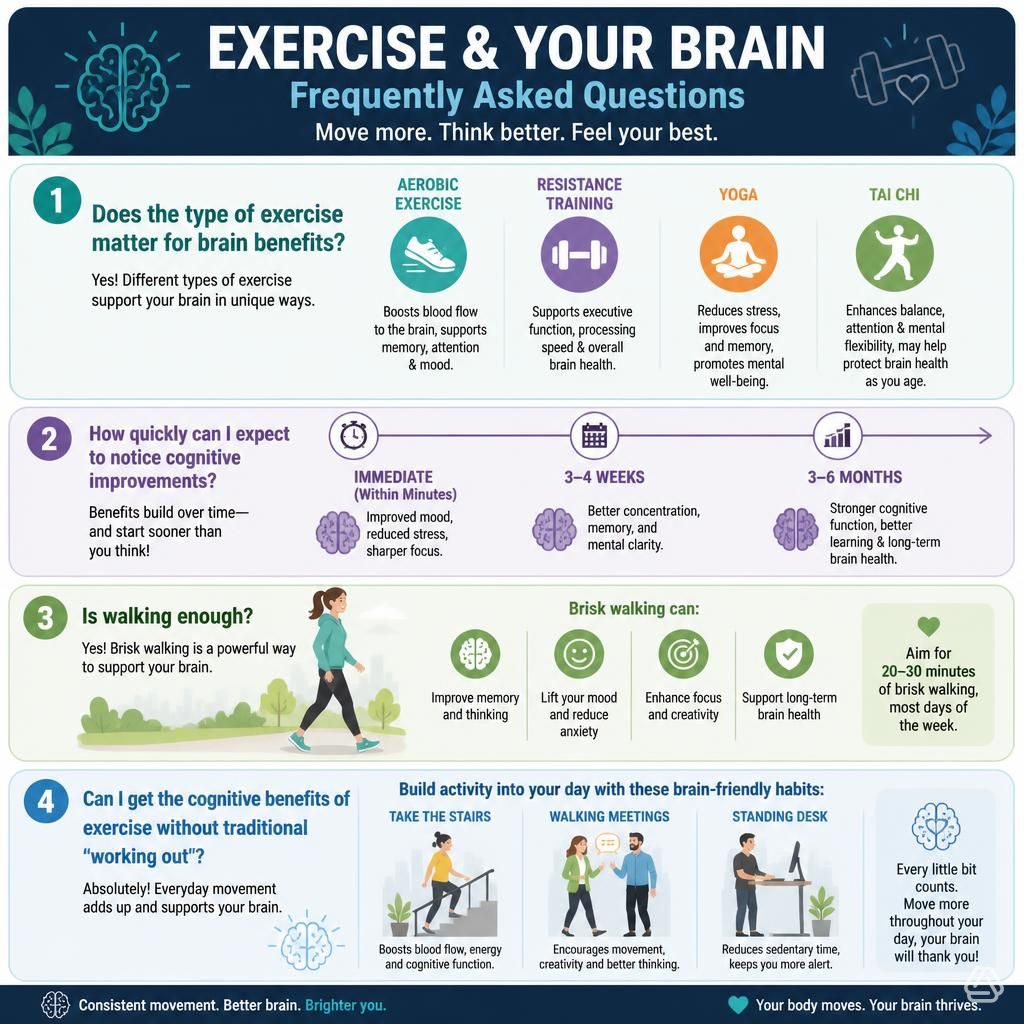
Frequently Asked Questions
❓ Does the type of exercise matter for brain benefits?
Aerobic exercise has the strongest and most consistent evidence for cognitive benefits, particularly for BDNF production and hippocampal neurogenesis. However, resistance training, yoga, and Tai Chi each offer unique cognitive benefits through distinct mechanisms. An ideal brain exercise program combines aerobic exercise (primary) with resistance training (secondary) and stress-reducing mind-body movement — but any one of these, done consistently, is vastly better than none.
❓ How quickly can I expect to notice cognitive improvements?
Acute improvements in focus, attention, and processing speed occur immediately after a single exercise session and last 1–3 hours. Sustained improvements in memory and executive function emerge at 3–4 weeks of consistent practice. Structural brain changes — including hippocampal volume increases — develop over 3–6 months of regular aerobic training.
❓ Is walking enough?
Yes — especially for beginners. Brisk walking at Zone 2 intensity (fast enough that conversation is slightly effortful, but not impossible) produces the same BDNF response and hippocampal benefits as running at the same relative intensity. Walking is consistently underrated as a cognitive enhancement tool, and the research on it is robust. If walking is what you can do right now, walking is exactly what you should do.
❓ Can I get the cognitive benefits of exercise without traditional “working out”?
Active lifestyle habits — taking stairs, walking meetings, using a standing desk, active commuting — produce measurable cognitive benefits compared to fully sedentary behaviour. However, structured aerobic sessions produce larger and more consistent BDNF responses than incidental activity alone. Think of lifestyle activity as the floor, not the ceiling. Build it in everywhere you can — then add dedicated sessions on top.
The Bottom Line
Your brain is not separate from your body. What you do with your body — how you move it, how often, how vigorously — determines the neurochemical environment your brain operates in every single day. BDNF levels. Hippocampal volume. Dopamine. Norepinephrine. Cortisol. Cerebrovascular integrity. Grey matter density. These are not abstract biology terms. They are the physical substrate of your attention, your memory, your decision-making, your mood, and your long-term cognitive resilience.
Exercise is not a luxury for fit people. It is not a hobby for athletes. It is the most powerful cognitive maintenance tool available to every human being on earth — and it costs nothing but time, and far less time than you probably think.
A 10-minute walk matters. It produces real neurochemical effects. It moves the needle. And if you do it tomorrow, and the day after, and the week after, you will — measurably, structurally, biologically — have a better brain for it. 🧠⚡
Start today. Even 10 minutes. Your brain is ready when you are.
Explore the full WellnessWays Brain & Cognition series → The Brain Clarity Foundation Protocol
Key References: Erickson et al. (2011), Proceedings of the National Academy of Sciences — hippocampal volume and aerobic exercise in older adults. | Ratey, J.J. & Hagerman, E. (2008), Spark: The Revolutionary New Science of Exercise and the Brain, Little, Brown. | Eriksson et al. (1998), Nature Medicine — neurogenesis in the adult human hippocampus. | Hillman et al., University of Illinois Neurocognitive Kinesiology Lab — exercise and executive function. | British Journal of Sports Medicine — minimum effective dose aerobic exercise and cognitive outcomes.
This article is for informational purposes only and does not constitute medical advice. Consult your physician before beginning any new exercise program.
Published on WellnessWays.net | Category: Brain & Cognition | © 2026 WellnessWays.net